In this article
Combi boilers are a popular choice in UK homes. One compact unit on the wall gives you both heating and hot water, with no cylinder in the airing cupboard and no tanks in the loft.
This guide explains how a combi works, what it does well, where it falls short, and how to tell whether one is right for your home.
Quick answer
- What it is: a boiler that heats your radiators and heats hot water straight from the mains as you use it, so nothing is stored.
- Best for: homes where hot water is usually needed in one place at a time, with a good mains water supply.
- Less suited to: homes where several showers often run at once, or where the mains supply is weak.
- With BoxHeat: a new combi starts from £1,799 fitted (correct in November 2026).
How a combi boiler works
"Combi" is short for combination: the boiler combines a central heating boiler and a water heater in one unit.
When the heating is on, the boiler heats water that circulates around your radiators in a sealed system. When you turn on a hot tap or shower, the boiler switches to hot water and heats cold water from the mains as it passes through. Hot water takes priority, so the radiators pause briefly while a tap is running.
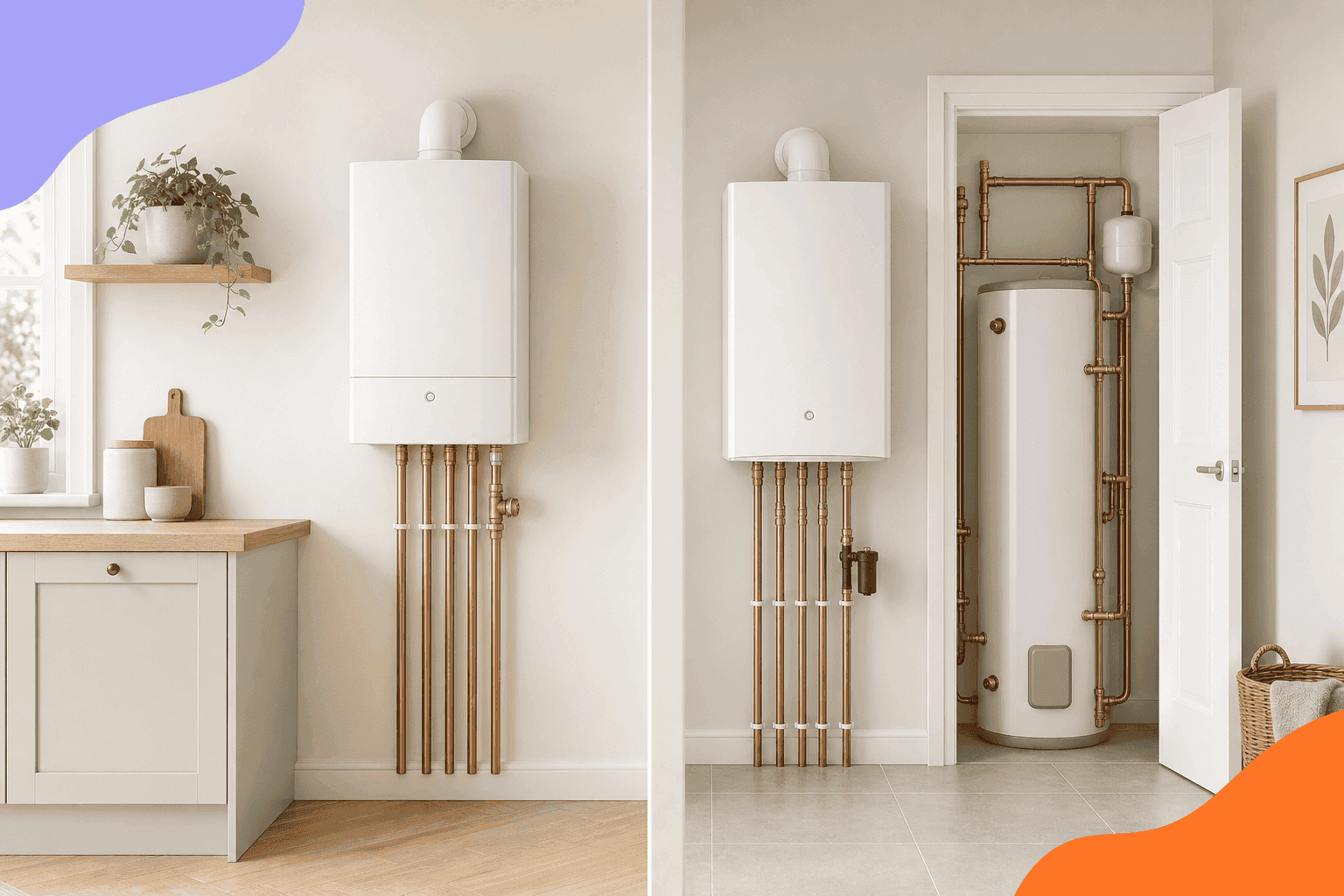
The pump and expansion vessel are built into the boiler, so there's no separate hot water cylinder, no cold water tank and no feed and expansion tank in the loft. The heating has a pressure gauge on the boiler, and our boiler pressure guide explains what it should read.
Advantages of a combi boiler
- Hot water on demand. There's no cylinder to heat up first, and no stored supply to run out.
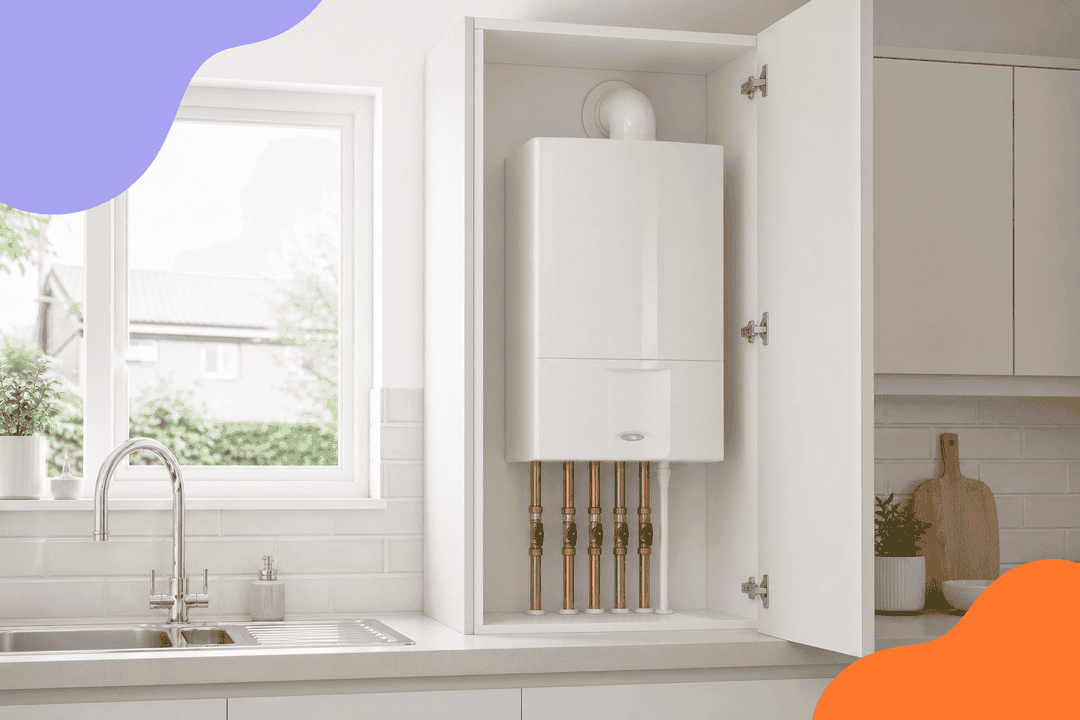
- Saves space. No cylinder or loft tanks, so the airing cupboard and loft are free. Many combis fit inside a standard kitchen wall cupboard.
- Mains-pressure hot water. With a good mains supply, showers are usually stronger than on a tank-fed system, without a separate shower pump.
- No heat lost from stored water. Water is only heated when you use it.
- Usually the lowest installed price. There's less to fit, so a like-for-like combi replacement is normally the simplest job.
Disadvantages of a combi boiler
- Flow is shared. A combi heats a set amount of water each minute. If two showers run at once, they share it, and both get weaker.
- It depends on your mains. A combi can't deliver more water than comes into your home. A weak supply means weak hot water, whatever size of boiler you choose.
- No backup. If the boiler breaks down, you have no hot water. A cylinder with an electric immersion heater gives a backup; a combi doesn't.
- Not ideal for a future heat pump. Most heat pumps work with a hot water cylinder, so a cylinder would need adding later.
Is a combi boiler right for your home?
Bedrooms matter less than you might think. The better question is how often your household needs hot water in more than one place at the same time.
A combi usually suits you if
- you have one bathroom, or a second one that's rarely used at the same time
- you'd like to free up the airing cupboard or loft
- your mains water flow and pressure are good
A system boiler may suit you better if
- you have two or more bathrooms often in use together
- your mains supply is weak
- you want stored hot water as a backup, or plan a heat pump
Our combi vs system boiler guide compares the two in more detail, and our system boiler guide explains how stored hot water works.
What size combi boiler do you need?
A combi's size in kilowatts (kW) mainly decides how much hot water it can deliver each minute. Manufacturers quote this as a flow rate, usually based on heating the water by 35°C. These are the typical figures for the combis we fit:
| Combi output | Typical hot water flow | Usually suits |
|---|---|---|
| 24 to 26kW | About 10 litres a minute | Flats and smaller homes with 1 bathroom |
| 28 to 30kW | About 11.5 to 12.5 litres a minute | Typical 3-bed homes with a bathroom and a separate shower |
| 35 to 36kW | About 14 to 15 litres a minute | Larger homes with 2 bathrooms and a good mains supply |
| 40kW and above | About 16 to 20 litres a minute | Larger homes with high hot water demand |
Flow rates from the manufacturers' figures for the boilers we fit, correct in October 2026.
Bigger isn't always better: an oversized boiler costs more and can switch on and off too often when heating your home. Our boiler size guide explains how to choose.
How much does a combi boiler cost?
Our combi prices are fixed and include a standard like-for-like installation. We fit combis from five manufacturers, from £1,799 up to £4,170 for our largest models:
| Brand | Combi range | BoxHeat price, fitted |
|---|---|---|
| Glow-worm | Compact | From £1,799 |
| Worcester Bosch | Greenstar 1000, 2000 and 8000+ | From £2,050 |
| Baxi | 400, 600 and 800 | From £2,290 |
| Viessmann | Vitodens 050-W and 100-W | From £2,330 |
| Ideal | Logic Combi Plus 2 and Logic Max | From £2,570 |
Correct in November 2026. Prices vary by model and output.
You can compare every model on our Worcester Bosch, Baxi, Viessmann, Ideal and Glow-worm pages. Manufacturer warranties on these combis range from 5 to 12 years depending on the model, and each boiler's page shows its warranty. We register the warranty for you, subject to the manufacturer's terms. Our boiler warranty guide explains what's covered and how to keep it valid. Every combi we install also comes with a wireless room thermostat as standard, and a carbon monoxide alarm is available free with every installation.
If your home needs extra work, such as converting from a system or regular boiler or moving the boiler, it's included in your fixed quote. Our new boiler cost guide explains what affects the price. Monthly finance is available, subject to status. See finance options.
Switching to a combi
If you have a system, regular or back boiler now, you can switch to a combi. The cylinder comes out, and with a regular boiler the loft tanks are no longer needed. We convert all three to combis, and the conversion work is included in your fixed price. Our guide to converting to a combi explains what's involved, and our back boiler replacement guide covers back boilers.
If you smell gas
- Open doors and windows.
- Don't smoke, light matches or use any naked flame.
- Don't switch electrical items on or off, including lights.
- Turn off the gas at the emergency control valve next to the meter, if you can safely reach it and it isn't in a cellar or basement.
- Leave the property and, once outside, call the National Gas Emergency Service on 0800 111 999. It's free and open 24 hours a day.
Combi boiler questions
See your fixed price for a new combi boiler
Get my fixed priceReviewed by our technical team. All BoxHeat articles are written by experienced heating professionals and reviewed by our team of Gas Safe registered engineers to ensure accuracy, safety, and compliance with current UK building regulations and manufacturer guidelines.