In this article
Wondering how much it costs to replace a boiler?
Most homeowners in the UK can expect to pay between £1,800 and £3,500+ for a new boiler installation, but the final price depends on several factors, including the type of boiler you choose, your existing heating system and the complexity of the installation.
At BoxHeat, we believe pricing should be clear from the start. Instead of providing a rough estimate and arranging a home survey before giving you a final price, our online quotation system asks a series of questions about your property and heating system to calculate a fixed installation price that's tailored to your home.
In around 60 seconds you can:
• Compare suitable boilers
• Receive a fixed installation price
• Choose your preferred installation date
• Book online when you're ready
Quick Answer
If you're looking for a quick answer, a straightforward boiler replacement in the UK typically costs:
| Boiler Type | Typical Installed Price |
|---|---|
| Combi Boiler | £1,800–£3,000 |
| System Boiler | £2,300–£3,500 |
| Regular (Heat-Only) Boiler | £2,200–£3,400 |
These prices are intended as a general guide for straightforward domestic installations.
Your actual installation price will depend on your chosen boiler, your existing heating system, whether you're changing boiler type, relocating the boiler or carrying out any additional work.
With BoxHeat, your installation price is calculated using the information you provide during your online quote, helping you understand the total cost before you book.
Why Do Boiler Replacement Costs Vary?
Many homeowners wonder why one company advertises a boiler from £1,995 while another quote is significantly higher.
The answer is simple.
No two boiler installations are exactly the same.
Some homes need very little work, while others require pipework alterations, gas pipe upgrades, a new flue route or even a complete change from one heating system to another.
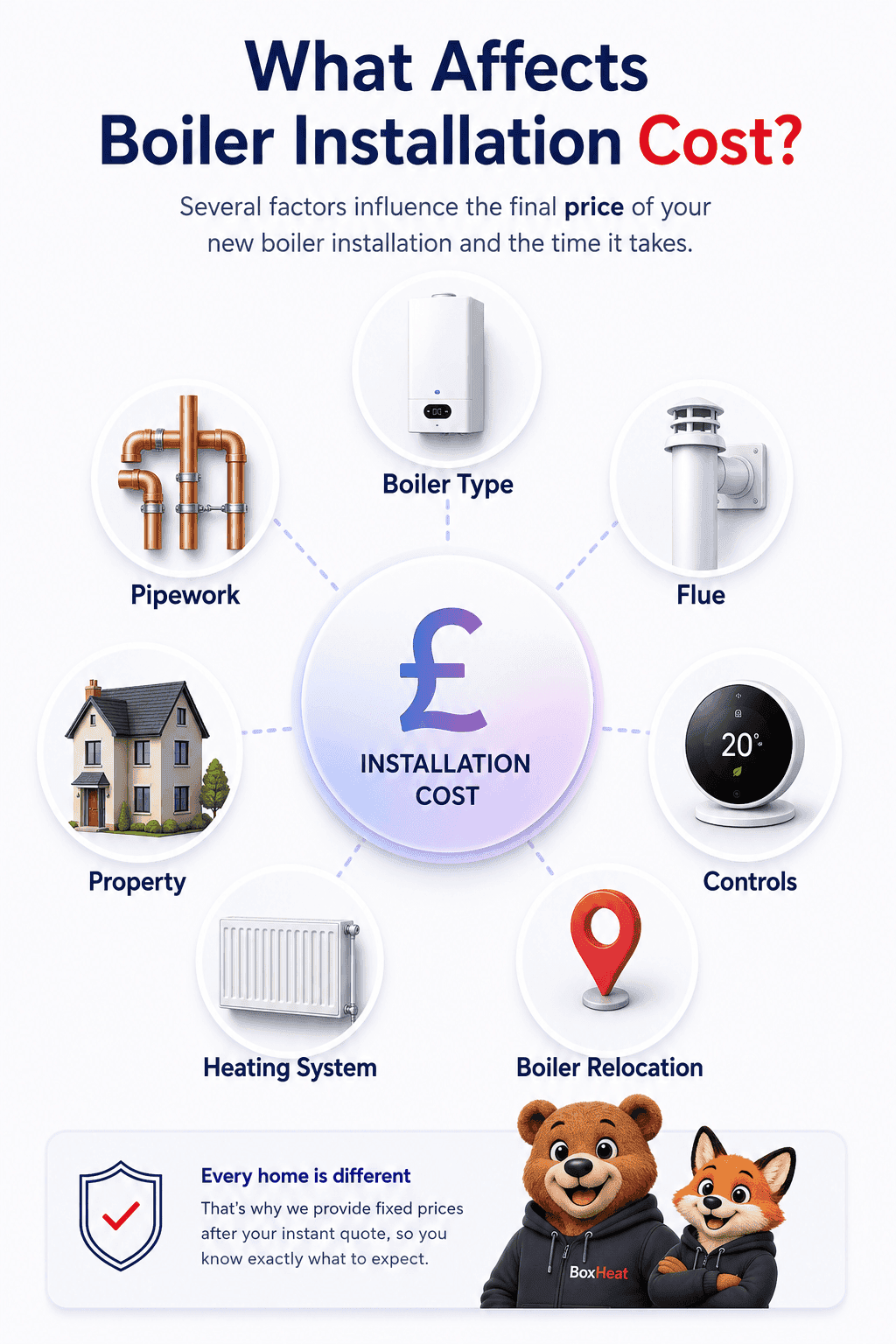
The main factors affecting the price include:
• Boiler type
• Boiler size (kW)
• Your current heating system
• Installation complexity
• Boiler location
• Pipework alterations
• Flue requirements
• Heating controls
• Additional installation work
Understanding these factors makes it much easier to compare quotations fairly and avoid unexpected costs.
How BoxHeat Calculates Your Boiler Replacement Cost
One of the biggest frustrations homeowners have when replacing a boiler is receiving an estimated price online, only to discover the final cost changes after a home survey.
Instead of giving you a rough estimate, our online questionnaire asks a series of questions about your property and existing heating system to build a personalised installation price before you book.
By understanding your home and installation requirements upfront, we can recommend suitable boilers and provide a fixed installation price that's tailored to your property.
During your online quote, we'll ask about:
• Your current boiler type
• Your property's fuel type
• Whether you're replacing the boiler like-for-like or changing boiler type
• The location of your existing boiler
• Whether you'd like the boiler relocated
• Your property type
• The number of bedrooms and bathrooms
• The position of the flue
• Roof type (where applicable)
• Other installation details that may affect the work required
Every answer helps us build a more accurate installation price.
Once you've completed the questionnaire, you'll be shown suitable boilers together with a fixed installation price, allowing you to compare your options before deciding whether to book.
Why do we ask for photos after you've booked?
After you've placed your order, we'll ask you to upload photographs of your existing boiler and surrounding pipework.
These photographs allow our technical team to confirm that everything matches the information provided during your online quote and ensure your installation has been priced correctly.
In most cases, this is simply a final verification step before your installation date.
If the photographs identify something that couldn't reasonably have been established during the online quotation, we'll contact you to discuss the options before any installation work takes place.
This helps avoid unexpected issues on installation day while ensuring you always know exactly what's happening.
Typical Boiler Installation Costs by Installation Type
Replacing a boiler with the same type of boiler is usually the most straightforward and cost-effective option.
Changing from one type of heating system to another often requires additional labour, materials and alterations to your existing pipework, which increases the overall installation cost.
The table below provides typical guide prices for the most common types of boiler installation.
| Installation Type | Typical Installed Price |
|---|---|
| Combi → Combi replacement | £1,800–£3,000 |
| System → System replacement | £2,300–£3,500 |
| Regular → Regular replacement | £2,200–£3,400 |
| System → Combi conversion | £3,000–£4,800+ |
| Regular → Combi conversion | £3,200–£5,000+ |
| Back Boiler → Combi conversion | £3,800–£6,000+ |
| Boiler relocation | Typically +£300–£1,500 |
These prices are intended as a guide only.
The final cost depends on factors including the boiler model you choose, your property's layout, any pipework alterations, gas supply upgrades, flue requirements and the work identified during your online quotation
What Affects the Cost of Replacing a Boiler?
Every home is different, which means no two boiler installations are exactly the same.
While many installations can be completed in a single day, several factors influence the overall installation cost.
Boiler Type
The type of boiler you choose has the greatest impact on the installation price.
Combi boilers are generally the most straightforward to install because they heat water directly from the mains and don't require a separate hot water cylinder.
System and regular boilers work differently and often require additional components, making them more expensive to install.
If you're unsure which boiler is right for your home, see our Boiler Types guide.
Boiler Output (kW)
Choosing the correct boiler size is just as important as choosing the right boiler type.
A boiler that's too small may struggle to meet your heating and hot water demands, while an oversized boiler can reduce efficiency and increase running costs.
The correct output depends on factors such as:
• The size of your home
• The number of radiators
• The number of bathrooms
• Your household's hot water demand
Our online quotation recommends suitable boilers based on the information you provide, helping you choose an appropriately sized boiler for your property.
Like-for-Like Replacement
Replacing your existing boiler with the same type of boiler is usually the simplest and most cost-effective option.
For example:
• Combi to combi
• System to system
• Regular to regular
These installations often require fewer alterations than changing to a different heating system.
Boiler Conversions
Converting from one boiler type to another is usually more complex.
Examples include:
• System to combi
• Regular to combi
• Back boiler to combi
These installations often involve removing redundant equipment, altering heating pipework, installing a new flue and making changes to your heating system.
Although conversions cost more initially, many homeowners choose them to free up space or modernise an older heating system.
Boiler Location
Where your new boiler is installed can have a significant impact on the overall installation cost.
Replacing your boiler in the same location is usually the simplest option because the existing gas, water and heating connections can often be reused with only minor alterations.
Moving a boiler to another room, into a loft or to a different floor generally requires additional labour and materials, which can increase the installation cost.
If you're considering relocating your boiler, our online quotation asks where your existing boiler is located and where you'd like your new boiler installed. This allows us to include the additional work in your personalised quote where possible.
For more information, read our Boiler Relocation Guide.
Pipework Alterations
Some installations require changes to the existing heating pipework.
This may be because you're changing boiler type, relocating the boiler or replacing an older heating system.
Pipework alterations can include extending existing pipework, rerouting heating pipes or modifying connections to suit your new boiler.
If these alterations are identified during your online quotation, they're included within your installation price.
Gas Pipe Upgrades
Modern boilers often require a higher gas flow than older appliances.
If your existing gas pipework doesn't meet the manufacturer's installation requirements, it may need upgrading to ensure your new boiler operates safely and efficiently.
Where a gas pipe upgrade is identified during your online quotation, it's included within your installation price.
Flue Requirements
Every condensing boiler requires a suitable flue to safely discharge combustion gases outside your property.
The type of flue required depends on factors including:
• Your boiler location
• The position of external walls
• The route the flue needs to take
• Your property's construction
Some installations only require a standard horizontal flue, while others need vertical flues, extensions or additional flue accessories.
Your online quotation includes questions about the flue location to help determine what's required before you book.
Heating Controls
Modern heating controls can improve comfort while helping to reduce energy consumption.
Every BoxHeat installation includes a wireless room thermostat as standard, unless you've selected upgraded smart heating controls during your quote.
What's Included with Every BoxHeat Installation?
When comparing boiler quotes, it's important to understand exactly what's included.
Some companies advertise a low headline price but charge extra for items that are essential to complete the installation.
At BoxHeat, we believe you should know exactly what's included before you book.
Every installation includes the work required to safely install, commission and register your new boiler.
Every BoxHeat installation includes:
• Your chosen boiler
• Installation by a Gas Safe registered engineer
• Wireless room thermostat (or upgraded smart controls if selected)
• Removal and responsible disposal of your old boiler
• Magnetic system filter
• Chemical system flush
• Chemical inhibitor treatment
• Boiler commissioning
• Gas safety and tightness testing
• Electrical connection and testing required for the boiler installation
• Manufacturer warranty registration
• Building Regulations notification
• Demonstration of your new boiler and heating controls
• Installation certification
• Clean and tidy work area on completion
Included where required
Every home is different.
Because your installation is priced using the information you provide during the online quotation, your personalised installation price can also include work such as:
• Gas pipe upgrades
• Pipework alterations
• Boiler relocation
• Horizontal, vertical or extended flue components
• Flue accessories, including plume management kits where required
• Condensate pipe alterations
• Condensate pipe insulation
• Heating system balancing
• Mini expansion vessel (where required)
• Carbon monoxide alarm where required by current regulations
If any of this work is identified during your online quotation, it's included within your fixed installation price before you book.
What isn't normally included?
Some work falls outside a standard domestic boiler installation and may require a separate quotation.
This may include:
• Asbestos removal
• Scaffolding or specialist access equipment
• Structural building work
• Electrical work unrelated to the boiler installation
• Plumbing work unrelated to the boiler installation
• Work required because the existing installation differs significantly from the information provided during your online quote
If any additional work is identified during the pre-installation photo verification, we'll explain the reason, discuss the available options and agree any changes with you before installation begins.
Is It Better to Repair or Replace Your Boiler?
Deciding whether to repair your existing boiler or replace it with a new one isn't always straightforward.
If your boiler is relatively new and the fault is minor, repairing it may be the most cost-effective option.
However, as boilers get older, repairs often become more frequent and replacement parts can become harder to source. At some point, replacing your boiler can become a better long-term investment than continuing to pay for repairs.
When repairing your boiler may be the better option
Repairing your boiler is often worthwhile if:
• Your boiler is less than 10 years old.
• The fault is relatively minor.
• Replacement parts are readily available.
• The repair cost is significantly less than the value of the boiler.
• Your boiler has been serviced regularly and is otherwise reliable.
If your boiler is still operating efficiently and hasn't experienced repeated breakdowns, a repair may extend its life for several more years.
Signs it may be time to replace your boiler
Replacing your boiler is often worth considering if you experience one or more of the following:
• Frequent breakdowns.
• Increasing repair costs.
• Difficulty finding replacement parts.
• Higher gas bills caused by poor efficiency.
• Inconsistent heating or hot water.
• Strange noises or recurring fault codes.
• Your boiler is over 10–15 years old.
Modern condensing boilers are generally much more efficient than older appliances and can provide improved reliability, better heating performance and lower energy consumption.
If your current boiler is becoming unreliable, replacing it before it fails completely can also help you avoid the inconvenience of losing heating and hot water unexpectedly.
Which Boiler Is Right for Your Home?
Choosing the right boiler is just as important as understanding the installation cost.
The best boiler for your home depends on several factors, including:
• The size of your property.
• The number of bathrooms.
• Your household's hot water demand.
• Your existing heating system.
• Available installation space.
Our online quote recommends suitable boilers based on the information you provide, helping you compare options that are appropriate for your home.
Combi Boilers
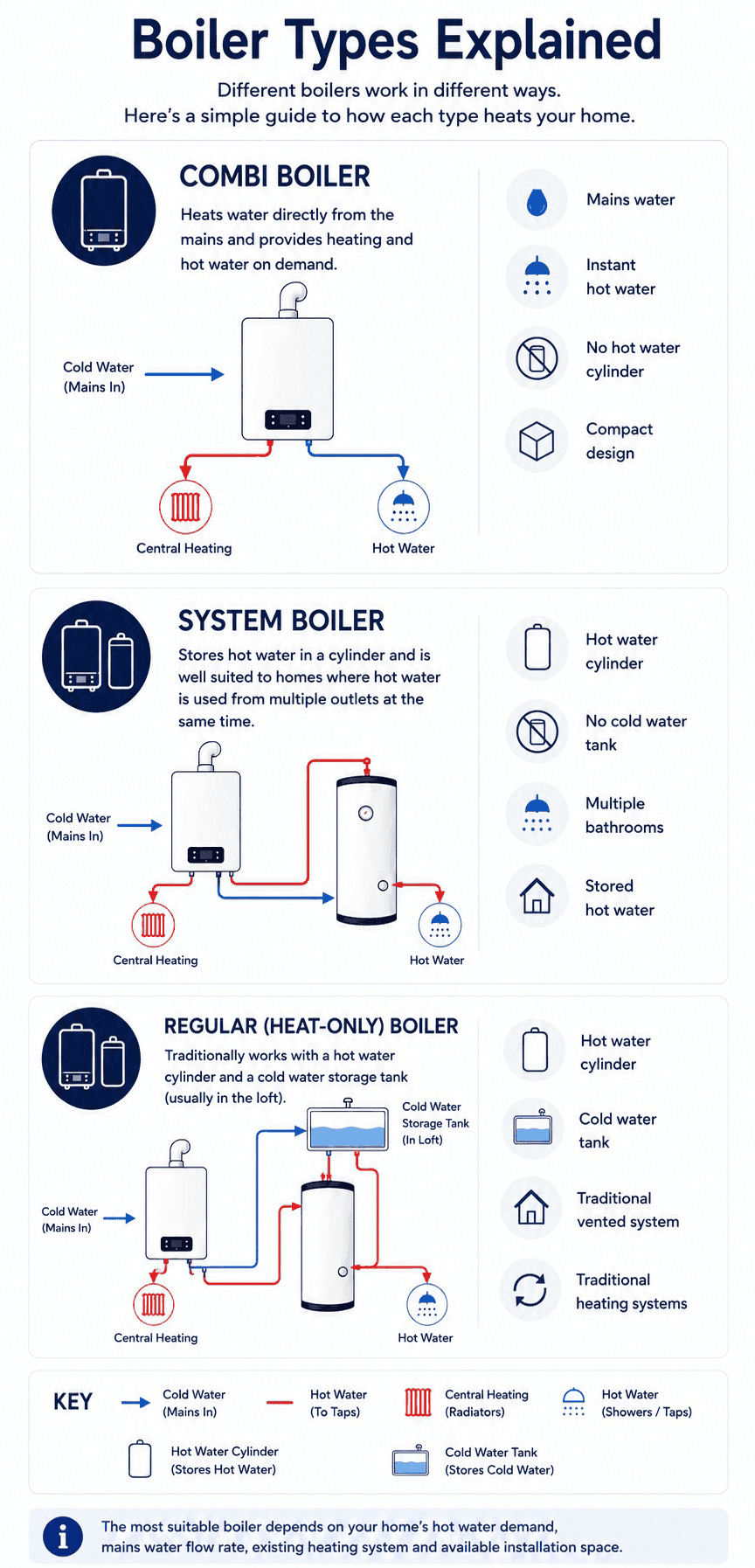
Combi boilers heat water directly from the mains, providing heating and hot water on demand without the need for a separate hot water cylinder or cold water storage tank.
They're typically the most popular choice for flats and smaller to medium-sized homes because they're compact, efficient and free up valuable storage space.
Read our Combi Boiler Guide to learn more.
System Boilers
System boilers store hot water in a separate cylinder, making them well suited to larger households where several taps or showers may be used at the same time.
They don't require a cold water storage tank, making them a good compromise between combi and regular heating systems.
Read our System Boiler Guide to learn more.
Regular Boilers
Regular boilers, also known as heat-only or conventional boilers, work with both a hot water cylinder and a cold water storage tank.
They're commonly found in older homes and may still be the best choice for some larger properties or where replacing the existing heating system isn't practical.
Read our Regular Boiler Guide to learn more.
Back Boiler to Combi Conversions
Many older homes still have back boilers installed behind a fireplace.
Replacing a back boiler with a modern combi boiler can improve efficiency, free up living space and provide more reliable heating and hot water.
Because these installations often involve removing the existing back boiler and fire, rerouting pipework and installing a completely new boiler, they're generally more complex than a straightforward boiler replacement.
If you're considering replacing a back boiler, read our Back Boiler to Combi Conversion Guide.
How Long Does a Boiler Replacement Take?
One of the most common questions homeowners ask is how long they'll be without heating and hot water.
For many straightforward like-for-like boiler replacements, installation can usually be completed within a single working day.
However, more complex installations may take longer.
This can include:
• Converting from a regular or system boiler to a combi boiler.
• Replacing a back boiler.
• Relocating the boiler.
• Extensive pipework alterations.
• Larger or more complex properties.
Your installation timescale depends on the work required for your individual property.
What Happens on Installation Day?
Although every installation is different, most follow the same general process.
- Your engineer arrives and prepares the work area.
- The existing boiler is safely disconnected and removed.
- Your new boiler and any required components are installed.
- The heating system is flushed and treated.
- The boiler is commissioned, tested and safety checked.
- Your warranty is registered.
- Your engineer demonstrates how everything works before leaving.
If you'd like a detailed walkthrough of every stage, read our Boiler Replacement Process guide.
Frequently Asked Questions
Ready to Find Out How Much Your Boiler Replacement Will Cost?
Every home is different, which is why the most accurate way to price a new boiler is with a personalised online quote.
In around 60 seconds you can compare suitable boilers, receive a fixed installation price and choose your preferred installation date.
There's no obligation to buy and no need to arrange a home survey before seeing your price.
Get your fixed online boiler quote today and see exactly how much your new boiler will cost.
Reviewed by our technical team. All BoxHeat articles are written by experienced heating professionals and reviewed by our team of Gas Safe registered engineers to ensure accuracy, safety, and compliance with current UK building regulations and manufacturer guidelines.