In this article
Combi and system boilers both provide central heating and hot water. The real difference is how they deal with hot water: a combi heats it as you use it, while a system boiler heats it in advance and stores it in a cylinder.
Neither is better for every home. The right choice depends on how much hot water your household uses at the same time, the strength of your mains water supply, the space you have and what you might want from your heating in the future. This guide explains how each type works, where they differ and how to work out which is likely to suit your home.
Quick answer
- Combi: can suit homes where space is tight and hot water is usually needed in one place at a time. It heats water straight from the mains, so there's no cylinder or loft tank.
- System boiler: can suit homes where several people regularly need hot water at the same time, provided there's room for a hot water cylinder.
- Also matters: your mains water flow and pressure, the space you have and any plans for a heat pump.
At a Glance
| Combi boiler | System boiler | |
|---|---|---|
| How hot water is provided | Heated from the mains as you use it | Heated in advance and stored in a cylinder |
| Hot water cylinder | Not needed | Needed |
| Cold water tank in the loft | Not needed | Not usually needed with an unvented cylinder |
| Space required | Less | More, to house the cylinder |
| Several hot taps or showers at once | Limited by the boiler's hot water output and your mains supply | Supplied from stored hot water, within the cylinder's capacity |
| Can hot water run out? | No stored supply to run out, but available flow is shared between outlets. | Yes. Stored hot water can run out and needs time to reheat. |
How a Combi Boiler Works
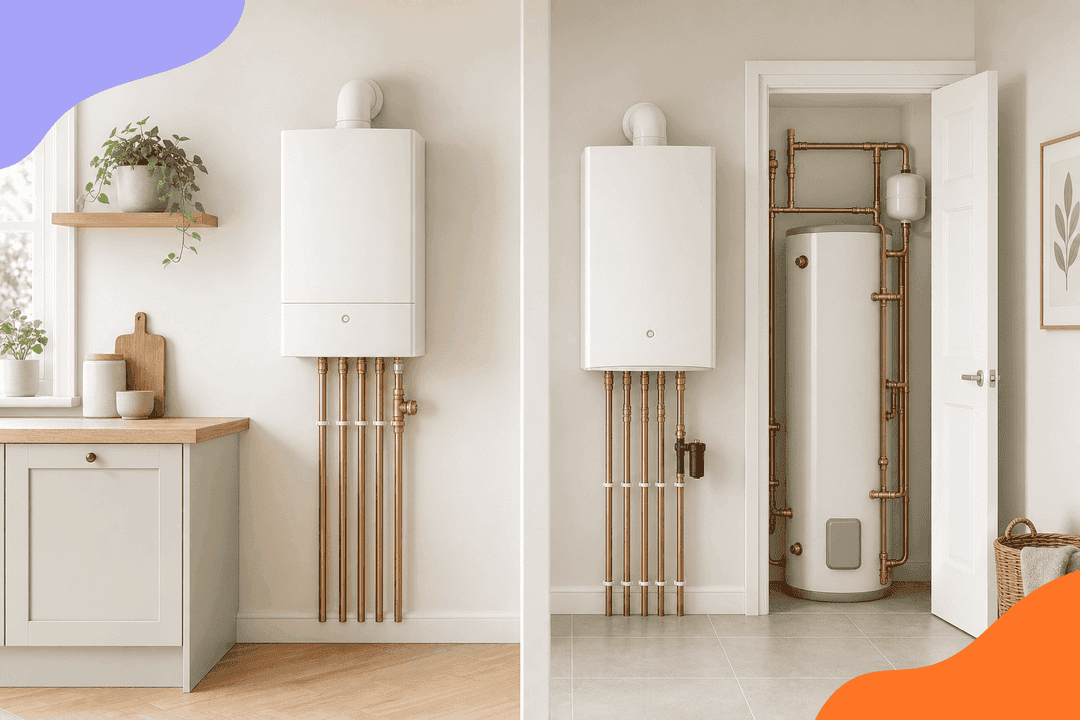
A combi, short for combination boiler, is a central heating boiler and water heater in one unit.
When you turn on a hot tap or shower, cold water from the mains passes through the boiler and is heated on its way to you. Nothing is stored, so there's no hot water cylinder and no cold water storage tank in the loft. Hot water is supplied directly from the mains, so a separate shower pump is not normally needed where the mains supply provides suitable pressure and flow.
Because a combi doesn't store water, it can't run out of hot water in the way a cylinder can. The trade-off is that there's nothing held in reserve: everything you use at any moment has to be heated at that moment.
Advantages of a combi boiler
- Hot water on demand, without waiting for a cylinder to heat up.
- Saves space, as there's no cylinder or loft tank.
- Fewer separate components in the system.
Things to consider
A combi's hot water performance depends on two things: the boiler's hot water output and the flow and pressure of your incoming mains supply. Even a powerful combi can't deliver more water than the property's mains supply provides.
If two showers run at once, or someone fills a bath while the washing machine is filling, the available flow is shared. In homes where that happens often, or where the mains supply is weak, a combi may struggle to keep everyone comfortable.
How a System Boiler Works
A system boiler heats water for your radiators and for a separate hot water cylinder. Key heating components, including the pump and expansion vessel, are built into the boiler itself, and the heating system is sealed and filled from the mains.
System boilers are commonly paired with an unvented cylinder, which is fed directly from the mains and stores hot water at mains pressure. In that arrangement, there's usually no need for a cold water storage tank in the loft. Because hot water is heated in advance, several taps and showers can draw from the stored supply at the same time.
Advantages of a system boiler
- Stored hot water can supply more than one outlet at a time.
- Can suit households with higher hot water demand.
- No cold water tank is usually needed when paired with an unvented cylinder.
- Many cylinders include an electric immersion heater, which can provide hot water if the boiler is out of action.
- A cylinder-based system is generally easier to adapt for solar water heating or a future heat pump.
Things to consider
You'll need space for the cylinder, often in an airing cupboard. Stored hot water can also run out: once the cylinder is used up, it needs time to reheat. How much hot water is available depends on the size of the cylinder and how quickly it recovers.
A cylinder also loses some heat over time, even when well insulated. Unvented hot water cylinders are subject to specific safety requirements under Building Regulations, so they must be installed by someone competent to carry out the work. Cylinder manufacturers also set their own servicing requirements.
Our guide to system boilers covers how they work, sizes and prices in more detail.
Combi vs System Boiler: The Key Differences
Both types heat your radiators in much the same way. The differences show up almost entirely in hot water:
- Hot water supply: a combi heats water as it's used; a system boiler heats it in advance and stores it.
- Simultaneous use: a combi shares its output and your mains flow between outlets; a system boiler supplies several outlets from the cylinder until the stored water runs low.
- Space: a combi needs only room for the boiler; a system boiler also needs room for a cylinder.
- Backup: with a combi, a boiler breakdown means no hot water; a cylinder with an immersion heater gives you an electric backup.
- Future flexibility: if you're considering a heat pump in future, having space for a suitable hot water cylinder may give you more flexibility.
Which Type Suits Your Household?
The number of bedrooms can be useful context, but it doesn't tell you on its own which boiler type is right for your home. A better question is: how often does your household need hot water in more than one place at the same time?
A combi may suit you if:
- Hot water is usually needed in one place at a time.
- You have one main bathroom, or additional bathrooms are rarely in use at the same time.
- Space is limited and you'd like to free up an airing cupboard or loft.
- Your mains water flow and pressure are good.
A system boiler may suit you if:
- Several people regularly need hot water at the same time, for example morning showers in more than one bathroom.
- You already have a system boiler and cylinder that suit the way you live.
- You have space for a cylinder.
- You'd like an immersion heater as a backup, or you're considering solar water heating or a heat pump in future.
When it's less clear-cut
Plenty of homes sit in between. A two-bathroom house where showers rarely overlap may be well served by a combi with a suitable hot water output and a good mains supply. A smaller home with a growing family might benefit from stored hot water. In these cases, how you actually use hot water, and the mains supply you have, should guide the decision.
Boiler type is also separate from boiler output. Once you've settled on a type, the boiler still needs an output that matches your home. Our boiler size guide explains the kW ratings, and our guide to boiler types covers all three main types, including regular boilers.
Should You Switch From One Type to the Other?
If your current boiler type works well for your household, replacing it like for like is usually the most straightforward option, as the existing pipework and layout are already in place.
System to combi
Switching from a system boiler to a combi can free up the space taken by the cylinder. It usually involves removing the cylinder and altering pipework, so it's more involved than a like-for-like replacement. It's worth being confident that a combi can meet your household's hot water demand before removing a cylinder that currently does the job. Our guide to converting to a combi boiler explains what's involved.
If a heat pump is in your future plans, bear in mind that most heat pumps work with a hot water cylinder. Switching to a combi now could mean putting a cylinder back in later.
Combi to system
Moving from a combi to a system boiler means finding space for a cylinder and adding the pipework to serve it. It's less common, but it can make sense if your household's hot water demand has outgrown what a combi can comfortably provide. We don't quote cylinder work online, but you can call us on 0345 905 7500 to talk it through.
Changing boiler type generally costs more than a like-for-like replacement. Our boiler replacement cost guide explains what affects the price.
Efficiency and Running Costs
Modern combi and system boilers are both condensing boilers, so the boiler type on its own isn't a reliable guide to running costs.
A system boiler heats stored water efficiently, but some heat is lost from the cylinder over time. A combi only heats water when it's needed, which often makes it the more efficient choice for smaller households.
In practice, how much hot water you use, how well the system is set up and the heating controls you have will usually make a bigger difference than the boiler type alone.
How BoxHeat Helps You Choose
Our online quote asks about your property, your existing heating system and what you need. We use your answers to recommend suitable boilers and give you a fixed installation price. If you're switching from a system or regular boiler to a combi, the conversion work is included in that price.
After you've placed your order, we ask for photos of your boiler, the area around it and the flue so our technical team can confirm everything matches your answers before installation day. You can see what's covered in our guide to what's included in a boiler installation, or get your fixed price now.
Combi vs system boiler questions
Not sure whether a combi or system boiler suits your home?
Get my fixed priceReviewed by our technical team. All BoxHeat articles are written by experienced heating professionals and reviewed by our team of Gas Safe registered engineers to ensure accuracy, safety, and compliance with current UK building regulations and manufacturer guidelines.