In this article
Most boilers have two temperature dials, one for the heating and one for the hot water, and most homes also have a room thermostat on the wall. They all do different jobs, and getting them right can make your heating cheaper to run without making your home any colder.
This guide explains what each setting does, what to set it to, and what changes if you have a hot water cylinder.
Quick answer
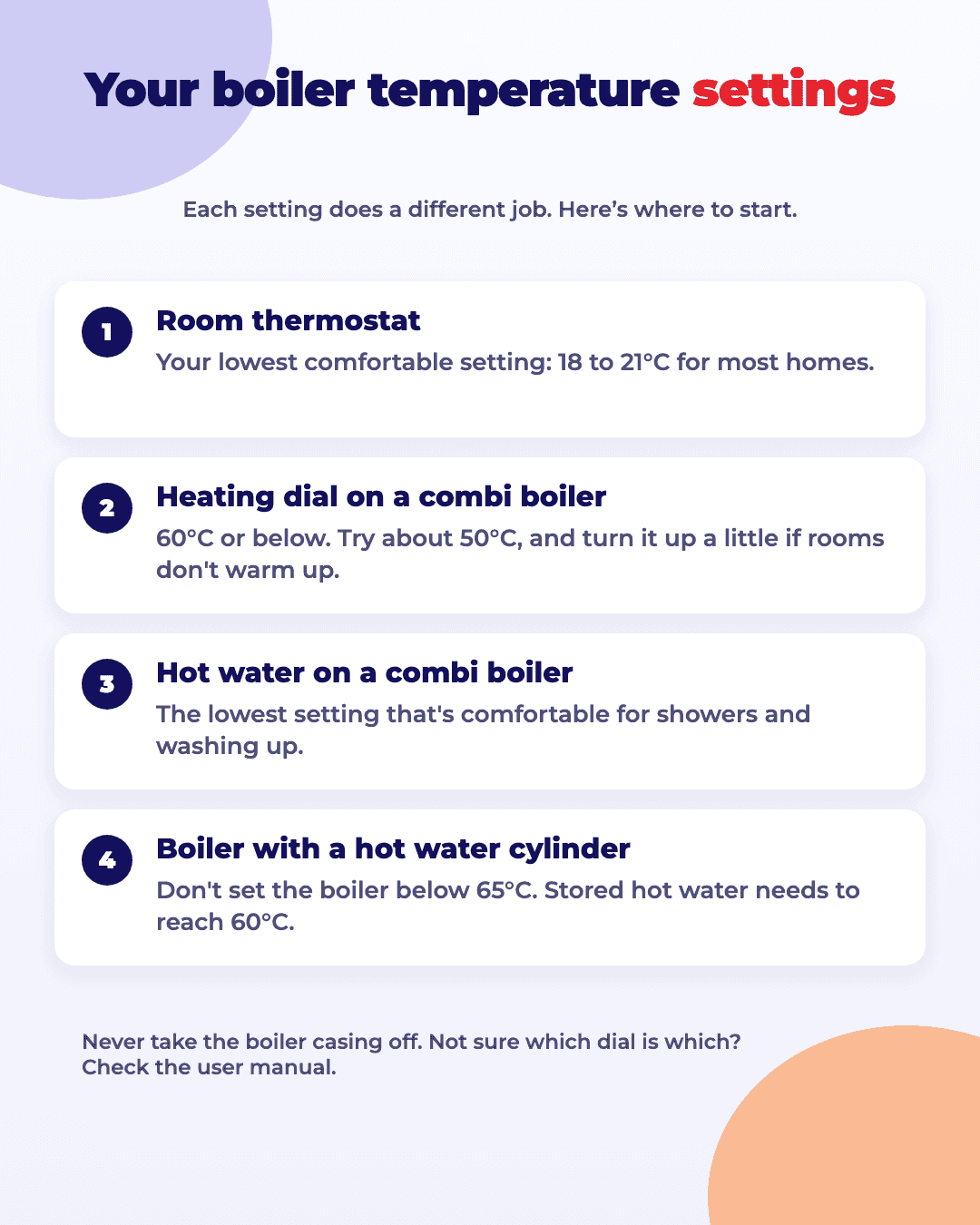
- Combi boiler heating: 60°C or below suits most homes. Try about 50°C, and turn it up a little if your rooms don't get warm enough.
- Combi boiler hot water: the lowest setting that's comfortable for showers and washing up.
- Boiler with a hot water cylinder: don't set the boiler below 65°C, because the stored water needs to get hot enough to stop bacteria growing.
- Room thermostat: the lowest temperature you're comfortable at. For most people that's 18 to 21°C.
Boiler temperature vs room thermostat: what's the difference?
It's easy to mix these up, but they control different things:
- The heating dial on the boiler sets how hot the water is when it leaves the boiler and goes round the radiators. This is called the flow temperature. It's usually marked with a radiator symbol.
- The hot water dial on the boiler sets how hot the water from your taps and shower is. It's usually marked with a tap symbol.
- The room thermostat measures the temperature in the room and switches the heating on and off to hold the temperature you set.
Some boilers show the settings as numbers or a scale from min to max rather than degrees.
What temperature should a combi boiler be set at for heating?
For most homes with a combi boiler, a heating (flow) temperature of 60°C or below works well. Many boilers are left at 70 to 80°C, which is hotter than most homes need.
The reason is how modern boilers work. Almost every gas boiler fitted in the UK today is a condensing boiler. It recovers extra heat from its exhaust gases, but it can only do that when the water coming back from the radiators is cool enough. When the heating dial is set high, the water comes back too hot and that extra heat goes out of the flue instead.
Worcester Bosch suggests homeowners try a heating setting of about 50°C and see if their home stays comfortable. Nesta, the charity behind the Money Saving Boiler Challenge, estimates that turning a combi down to 60°C or below saves an average home about £57 a year (based on the October to December 2026 price cap). Your own saving depends on your home and how you use your heating.
How to turn down the flow temperature on a combi boiler
- Find the heating dial or setting on the front of the boiler. It's usually marked with a radiator symbol. If you're not sure which is which, check the user manual.
- Turn it down to 60°C, or to about 50°C if you'd like to try lower.
- Leave it for a few days and see how your home feels.
- If rooms don't get warm enough, or take too long to heat up, turn it up a few degrees at a time until they do.
- In a very cold spell you may need to turn it up for a while. Turn it back down when the weather improves.
The settings are all on the front of the boiler or on its controls. Never take the casing off. If your heating is run by a smart thermostat, the flow temperature may be set through its app instead, so check its instructions.
Turning the heating dial down doesn't change how hot your taps and shower are on most combi boilers, because the hot water has its own setting. And if you change your mind, you can turn it straight back up.
What temperature should a combi boiler be set at for hot water?
A combi boiler heats water as you use it, so there's no tank of stored water to keep hot. That means the 60°C storage advice for hot water cylinders doesn't apply to a combi boiler.
Set the hot water dial to the lowest temperature that's comfortable for showers and washing up. A lower setting also reduces the risk of scalding, which matters if you have young children or older people at home.
If your hot water isn't getting hot at all, the setting probably isn't the problem. Our guide to a combi boiler with no hot water covers the checks.
Boilers with a hot water cylinder: system and regular boilers
If you have a system or regular boiler with a hot water cylinder, the advice is different. The water in the cylinder is stored, and stored hot water needs to reach 60°C to stop harmful bacteria such as Legionella growing.
The Energy Saving Trust advises not setting the boiler below 65°C if you have a hot water cylinder. Many cylinders also have their own thermostat. Leave that at 60°C or above.
Not sure which type of boiler you have? Our guide to boiler types explains how to tell a combi from a system or regular boiler.
What temperature should radiators be?
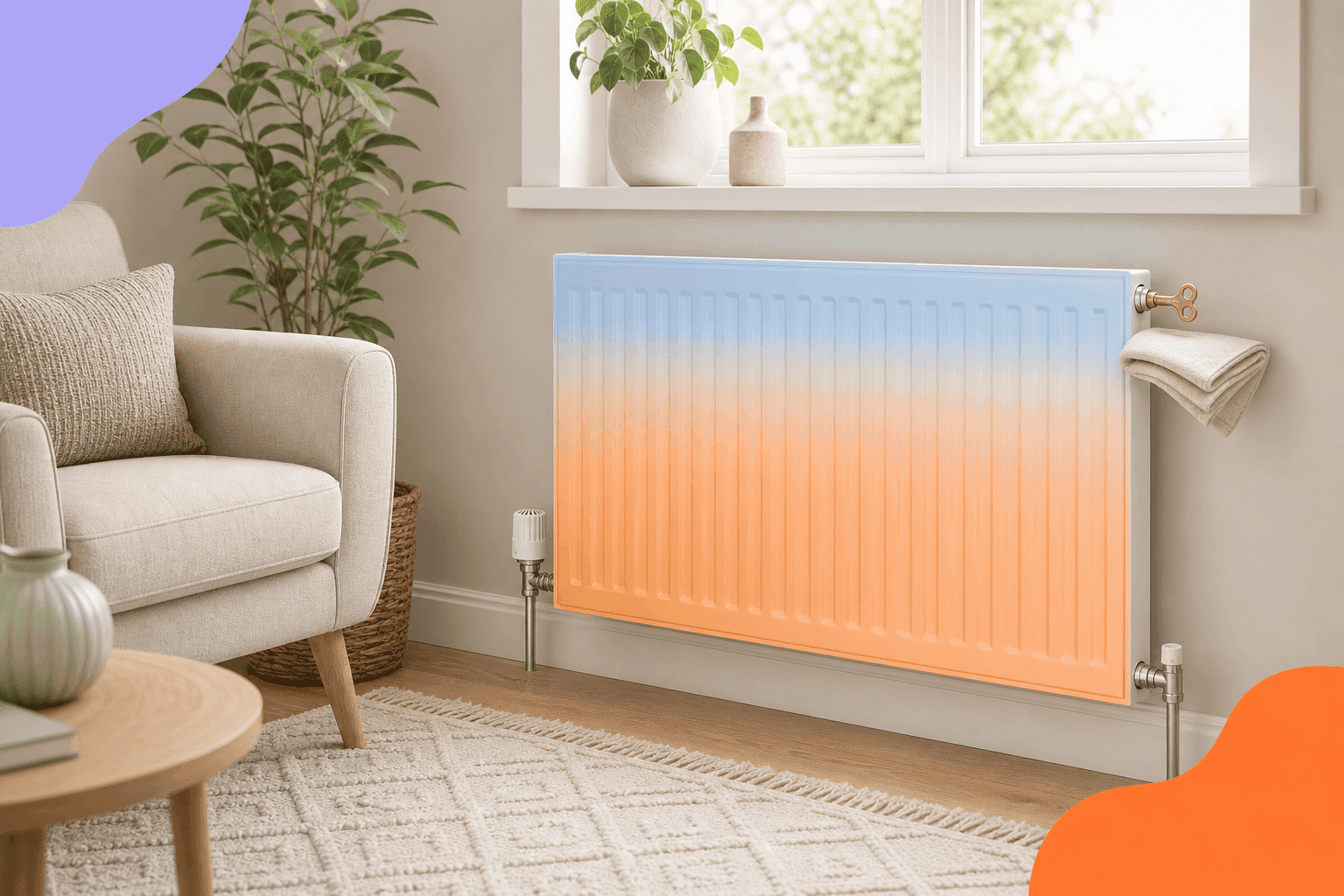
Radiators get roughly as hot as the water the boiler sends round, so the heating dial on the boiler sets how hot they feel. With a lower flow temperature, radiators feel warm rather than too hot to touch. Rooms take a little longer to warm up, but they still reach the temperature on your thermostat.
If some radiators stay cold at the top or bottom, the setting isn't usually the cause. Trapped air or sludge is more likely. Our guide to radiators not heating up shows how to bleed a radiator and what to check next.
What should the room thermostat be set at?
The Energy Saving Trust suggests setting the room thermostat to the lowest temperature you're comfortable at. For most people, that's between 18°C and 21°C. It estimates that turning it down from 22°C to 21°C could save about £120 a year in Great Britain.
Turning the thermostat up doesn't make the house warm up any faster. It just means the heating stays on for longer once it gets there. You also don't need to turn it up when it's colder outside, because the house still heats to the temperature you've set. It may just take a little longer.
If you're older, have reduced mobility or have a health condition, UK health advice is to heat the rooms you use most to at least 18°C.
A few other settings help too:
- The programmer or timer. Set the heating to come on about half an hour before you get up and go off about half an hour before bed.
- Thermostatic radiator valves (TRVs). These are the numbered heads on the radiators. Around 3 to 4 suits the rooms you use most, and 2 to 3 suits bedrooms and rooms you use less.
When a lower boiler temperature isn't the answer
Turning down the flow temperature suits a heating system that's working properly. It won't fix a problem. Have the system checked if:
- rooms never get warm, even with the heating dial turned up
- the boiler keeps cutting out or won't come on. Our guide to a boiler that won't fire up or keeps turning off covers the checks
- the pressure gauge keeps dropping. See our boiler pressure guide.
An older boiler that isn't a condensing model won't gain much from a lower setting. If your boiler is more than 10 to 15 years old or keeps breaking down, it may be time to compare the cost of a replacement. Our guide to how long a boiler lasts covers the signs.
If you smell gas
- Open doors and windows.
- Don't smoke, light matches or use any naked flame.
- Don't switch electrical items on or off, including lights.
- Turn off the gas at the emergency control valve next to the meter, if you can safely reach it and it isn't in a cellar or basement.
- Leave the property and, once outside, call the National Gas Emergency Service on 0800 111 999. It's free and open 24 hours a day.
Call the same number if your carbon monoxide alarm goes off, or if you think the boiler is making people unwell.
Getting a new boiler set up right
A new condensing boiler works best with sensible settings from day one. When BoxHeat fits a new boiler, the engineer shows you how the controls work, and a room thermostat comes as standard with our combi boilers.
A new combi boiler starts from £1,799 fully installed (correct in November 2026), with monthly finance available, subject to status. You can get your fixed price online in under 2 minutes.
Boiler temperature: your questions
Thinking about a new boiler? See your fixed price
Get my fixed priceReviewed by our technical team. All BoxHeat articles are written by experienced heating professionals and reviewed by our team of Gas Safe registered engineers to ensure accuracy, safety, and compliance with current UK building regulations and manufacturer guidelines.