In this article
A boiler that won't fire up, or one that keeps switching itself off, usually stops for a reason you can check. Often it's a setting, the pressure, the power or a frozen pipe rather than a broken part. This guide covers the checks that are safe to do yourself, what the boiler is telling you when it locks out, and when it's time to call a Gas Safe registered engineer.
Quick answer
- Check the thermostat is set above the room temperature and the heating is switched on.
- Check the boiler has power and gas: is the display on, and does your gas hob light?
- Check the pressure gauge. Below about 1 bar can stop the boiler.
- In freezing weather, check the condensate pipe outside isn't blocked with ice.
- If a fault code is showing, press reset once or twice. If it keeps locking out, call a Gas Safe registered engineer. Never take the casing off.
Why won't my boiler fire up?
When you turn the heating or hot water on, a modern boiler goes through a set routine: the fan starts, the gas valve opens, a spark lights the burner and a sensor checks the flame is there. If any step fails, it won't fire up. It also won't come on if nothing is telling it to, for example if the thermostat is set too low or the timer is off. The cause is usually one of these:
| What you notice | Likely cause | What to do |
|---|---|---|
| No lights or display at all | No power to the boiler | Check the switch next to the boiler and your fuse box |
| Display on, but no heating and no fault code | Nothing is telling it to come on: thermostat, timer or settings | Turn the thermostat up and check the timer and heating settings |
| Fault code, pressure below 1 bar | Low pressure | Top up the pressure, then press reset |
| Fault code in freezing weather, gurgling sound | Frozen condensate pipe | Thaw the pipe with warm water, then press reset |
| Clicking or ticking, then a fault code | It tried to light but couldn't, for example no gas or an ignition fault | Check your gas supply, reset once, then call an engineer |
| Fault code that comes back after a reset | A fault inside the boiler | Call a Gas Safe registered engineer |
Checks you can do yourself
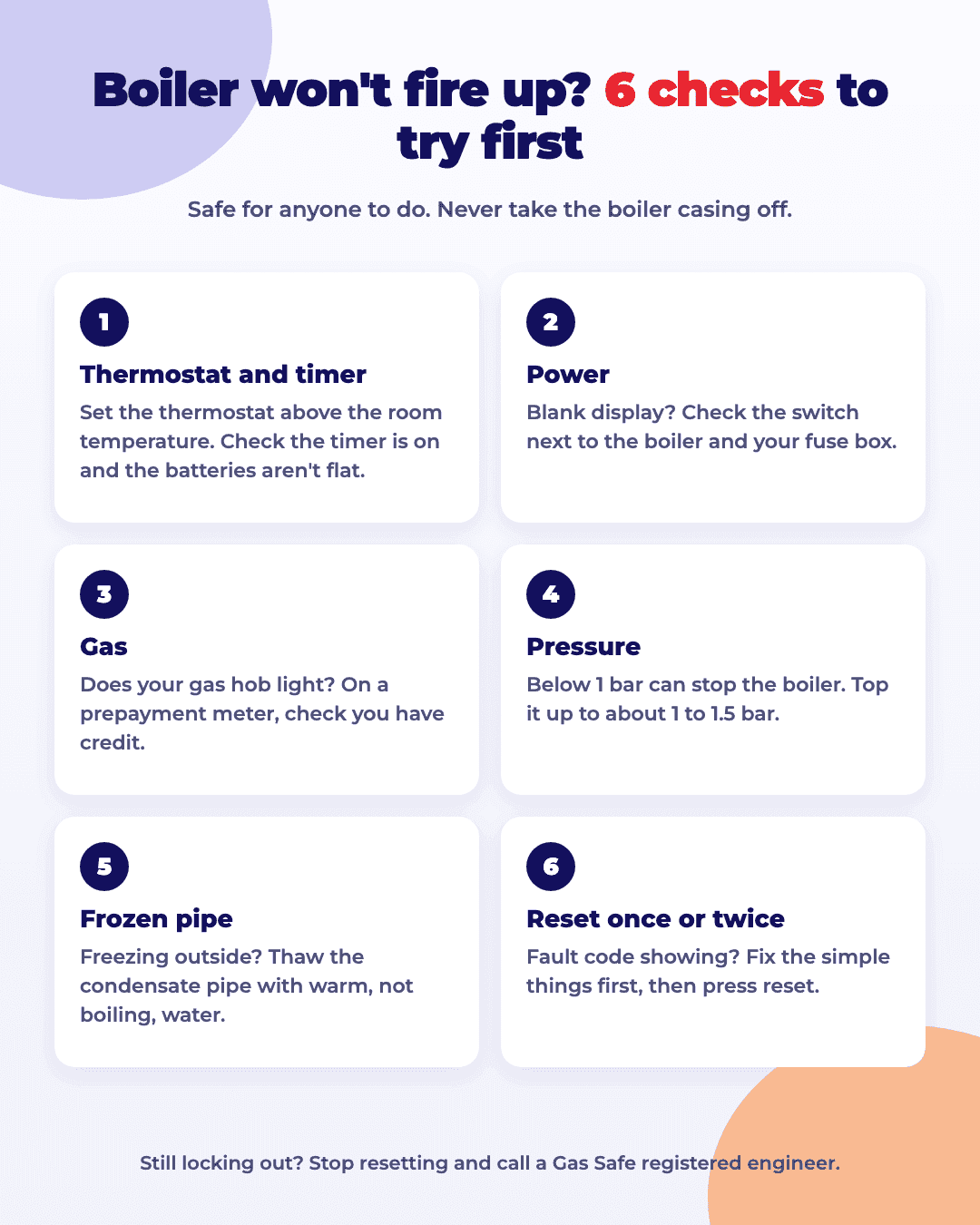
1. The thermostat, timer and settings
The boiler only comes on when the thermostat or timer tells it to. Turn the room thermostat up a few degrees above the current room temperature, and check the timer or programmer is in an 'on' period. If you have a wireless thermostat, try new batteries. Check the boiler itself hasn't been switched to hot water only or summer mode. After a power cut, the clock and programme can reset, so check those too.
A thermostat in a warm room can keep the boiler off for the whole house. If it sits in the same room as a radiator or cooker, it may think the house is warm enough.
2. Power to the boiler
If the boiler's display is blank, it has no power. Check the switched fused spur next to the boiler is on, and check your fuse box for a tripped switch. If other lights and sockets in the house aren't working either, it may be a power cut. If the fuse keeps tripping, don't keep resetting it: call an engineer.
3. The gas supply
If you have a gas hob, see whether it lights. If it doesn't, the problem is the gas supply rather than the boiler. If you have a prepayment meter, check you have credit, as the gas stops when it runs out.
4. The boiler pressure
Most combi and system boilers shut down if the pressure drops below about 1 bar, and show a fault code. Top it up to about 1 to 1.5 bar using the filling loop, then press reset. Our boiler pressure guide shows how. If you need to top up more than once every few weeks, there's probably a leak, so have it checked.
5. A frozen condensate pipe
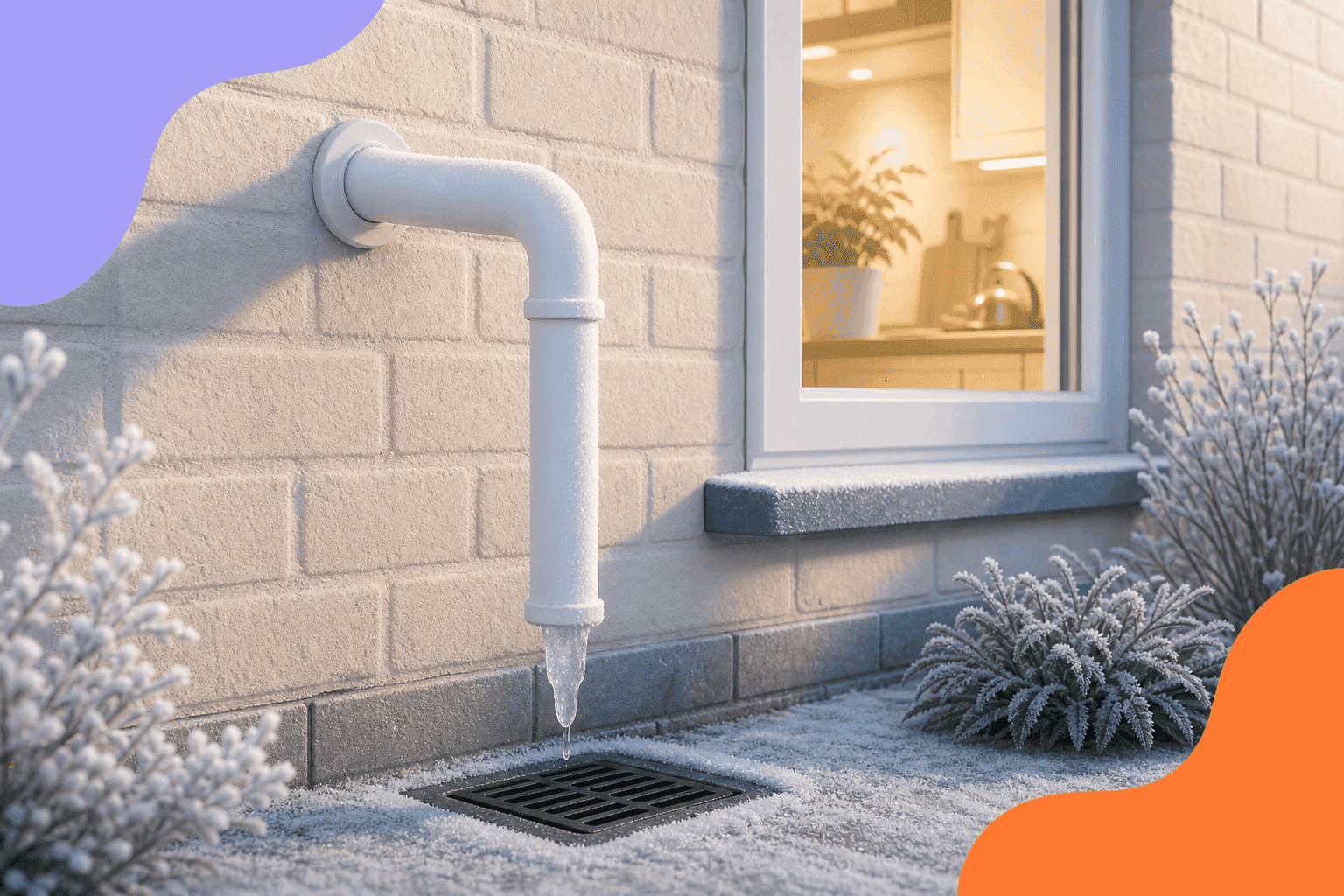
In freezing weather, the white plastic pipe that runs from the boiler to a drain outside can freeze. The boiler then stops and shows a fault code, and you may hear gurgling. Pour warm, not boiling, water along the outside section of the pipe, then press reset. Our frozen condensate pipe guide has the full steps.
What does it mean when a boiler locks out?
A lockout is the boiler shutting itself down for safety. It happens when the boiler tries to light and can't, or when it detects a problem such as low pressure, overheating or a blocked condensate pipe. Most boilers show a fault code or a flashing light, and won't restart until you press the reset button.
Look the code up in your boiler's manual, which most manufacturers publish online if you've lost yours. Fix anything simple first, such as the pressure or a frozen pipe, then press reset.
Pressing reset once or twice is fine. If the boiler locks out again, stop resetting it. Repeated lockouts mean there's a fault the boiler can't get past, and it needs a Gas Safe registered engineer.
Why does my boiler keep turning off?
A boiler that starts and then switches off again is usually protecting itself. Common reasons include:
- Low pressure. It may fire up, then cut out as the pressure falls. Check the gauge and top it up.
- A frozen or blocked condensate pipe. Water backs up and the boiler stops, often in cold snaps.
- Overheating. If water can't flow through the system properly, the boiler gets too hot and shuts down. Sludge in old pipework, a faulty pump or a closed valve can all restrict the flow.
- A thermostat problem. A faulty thermostat, or one in a warm spot, can switch the heating off too soon.
- Short cycling. A boiler that switches on and off every few minutes may be much bigger than the home needs, or set up poorly. It wastes gas and wears parts.
If only some radiators stay cold while the boiler runs, see our guide to radiators not heating up. If the heating works but there's no hot water, our combi boiler no hot water guide has checks for that.
When to call a Gas Safe registered engineer
Call a Gas Safe registered engineer if:
- the boiler still won't fire up after the checks above
- the same fault code keeps coming back after a reset
- you can hear clicking or ticking, but the burner never lights
- the fuse for the boiler keeps tripping
- the pressure keeps dropping and you can't see why
- you see scorch marks, soot or a lazy yellow or orange flame on an older boiler
Parts such as the fan, gas valve, ignition electrode, flame sensor, pump and circuit board are all inside the casing. Never take the casing off yourself. Only a Gas Safe registered engineer should work on them.
Older boilers with a pilot light
Modern condensing boilers don't have a pilot light. If you have an older boiler with one and it has gone out, follow the relighting instructions in the manual or on the boiler. If it won't stay lit, or relighting means removing a panel, leave it to an engineer.
If you smell gas
- Open doors and windows.
- Don't smoke, light matches or use any naked flame.
- Don't switch electrical items on or off, including lights.
- Turn off the gas at the emergency control valve next to the meter, if you can safely reach it and it isn't in a cellar or basement.
- Leave the property and, once outside, call the National Gas Emergency Service on 0800 111 999. It's free and open 24 hours a day.
Call the same number if your carbon monoxide alarm goes off, or if you think the boiler is making people unwell. Headaches, dizziness and nausea that ease when you leave the house can be a sign of carbon monoxide.
Repair or replace?
A one-off fault, such as a failed ignition electrode or sensor, is usually a straightforward repair, and it may be covered if the boiler is still under its manufacturer warranty. Check that first.
If your boiler is more than 10 to 15 years old, keeps breaking down, or needs an expensive part such as a new heat exchanger or circuit board, it's worth comparing the repair quote with the cost of a new boiler. Our guide to how long a boiler lasts covers the other signs.
BoxHeat doesn't repair boilers, but we do supply and fit new ones. A new combi boiler starts from £1,799 fully installed (correct in October 2026). You can get your fixed price online in under 2 minutes and compare it with your repair quote.
Boiler not firing up: your questions
Thinking about a new boiler? See your fixed price
Get my fixed priceReviewed by our technical team. All BoxHeat articles are written by experienced heating professionals and reviewed by our team of Gas Safe registered engineers to ensure accuracy, safety, and compliance with current UK building regulations and manufacturer guidelines.