In this article
Every boiler makes some noise. You'll usually hear a soft hum from the pump, a whirr from the fan and a quiet whoosh as the burner lights. What's worth paying attention to is a new sound, or one that's loud or irregular, such as banging, gurgling or whistling.
This guide explains what each common noise usually means, what you can safely check yourself, and when to call a Gas Safe registered engineer.
Quick answer
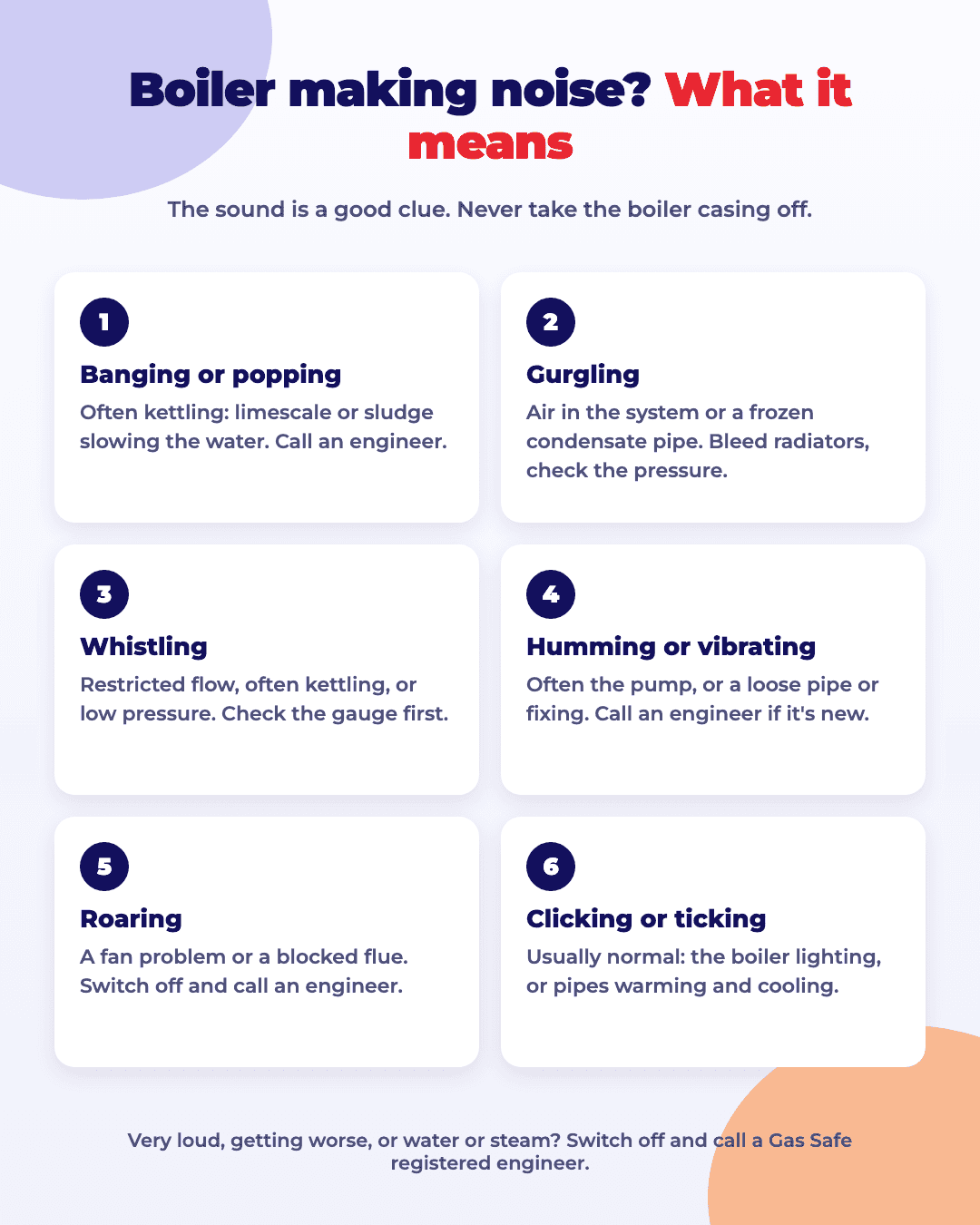
- Banging, popping or rumbling: often 'kettling', where limescale or sludge slows the water so it boils inside the boiler. It needs an engineer.
- Gurgling: usually air in the system, or a frozen condensate pipe in cold weather.
- Whistling: often the same restricted flow that causes kettling, or low pressure.
- Humming or vibrating: often the pump, or a loose pipe or fixing.
- Very loud, getting worse, or with water or steam: switch the boiler off and call a Gas Safe registered engineer. Never take the casing off.
What is that noise? Common boiler noises explained
| What you hear | Likely cause | What to do |
|---|---|---|
| Banging, popping or rumbling, a bit like a kettle | Kettling: limescale or sludge slowing the water | Call a Gas Safe registered engineer |
| Gurgling or bubbling | Air in the system, low pressure, or a frozen condensate pipe | Bleed the radiators, check the pressure, check the pipe outside |
| Whistling or high-pitched squealing | Restricted water flow, often from kettling, or low pressure | Check the pressure, then call an engineer |
| Humming or vibrating | The pump, or a loose pipe, clip or fixing | Call an engineer if it's new or getting louder |
| Roaring, like a jet engine | A fan problem or a blockage in the flue | Switch off and call an engineer |
| Clicking or ticking | Usually normal: the boiler lighting, or pipes warming up and cooling | Nothing, unless it clicks without lighting |
Banging, popping or rumbling: kettling
Kettling is one of the most common causes of a noisy boiler. The pump normally moves water quickly past the burner, so it never gets hot enough to boil. If something slows the water down, it can boil inside the heat exchanger, and the steam bubbles make a popping, rumbling or banging sound, like a kettle coming to the boil.
The usual causes are:
- Limescale. In hard water areas, scale can build up inside the heat exchanger and narrow the passages the water flows through.
- Sludge. Over time, radiators and pipes shed a black, iron-based sludge that collects in the system and slows the flow.
- A pump problem. If the pump isn't moving water fast enough, the water stays over the burner for too long.
- A faulty thermostat or sensor. The boiler may get the wrong reading and overheat.
Modern boilers have safety cut-outs that shut them down if they overheat, but kettling still needs fixing. The heat exchanger may need cleaning or replacing, and the system may need flushing. These aren't DIY jobs, so call a Gas Safe registered engineer.
Gurgling or bubbling
Gurgling usually means air is trapped in the system. You may also notice radiators that are cold at the top. Bleeding the radiators lets the air out. Our guide to radiators not heating up shows how. Bleeding lets a little water out too, so check the pressure afterwards and top it up to about 1 to 1.5 bar if it has dropped. Our boiler pressure guide explains how.
In freezing weather, gurgling can also mean the condensate pipe has frozen. That's the white plastic pipe that runs from the boiler to a drain outside. The boiler usually stops and shows a fault code. Our frozen condensate pipe guide shows how to thaw it safely with warm, not boiling, water.
Whistling or squealing
A boiler that whistles is often kettling: water squeezing through a heat exchanger narrowed by scale or sludge. Low pressure can also restrict the flow, so check the gauge first. If the pressure is fine and the whistling carries on, call a Gas Safe registered engineer.
Humming, vibrating or roaring
A steady low hum when the heating is on is normal. A loud hum or vibration is more often the pump. It may be running too fast, starting to wear, or working hard because of sludge in the system. A loose pipe clip or fixing near the boiler can also rattle or vibrate.
A roaring sound, like a jet engine, can point to a problem with the fan or a blockage in the flue. Switch the boiler off and call an engineer. The pump, fan and flue connections are all inside the casing or need specialist checks, so leave them to a Gas Safe registered engineer.
When to switch off and call an engineer
Switch the boiler off and call a Gas Safe registered engineer if:
- the banging or roaring is very loud, or getting worse
- you can see water leaking or steam coming from the boiler
- the noise comes with a fault code that keeps coming back
- the boiler keeps cutting out while it's making the noise
If the boiler is also cutting out or won't start, our guide to a boiler that won't fire up or keeps turning off covers the checks for that. Never take the casing off yourself.
If you smell gas
- Open doors and windows.
- Don't smoke, light matches or use any naked flame.
- Don't switch electrical items on or off, including lights.
- Turn off the gas at the emergency control valve next to the meter, if you can safely reach it and it isn't in a cellar or basement.
- Leave the property and, once outside, call the National Gas Emergency Service on 0800 111 999. It's free and open 24 hours a day.
Call the same number if your carbon monoxide alarm goes off, or if you think the boiler is making people unwell. Headaches, dizziness and nausea that ease when you leave the house can be a sign of carbon monoxide.
How to stop a new boiler kettling
Most kettling comes down to what's in the water. Clean water and fewer deposits keep the flow moving, which is why every BoxHeat installation includes:
- a chemical flush to clean sludge and debris out of the system before the new boiler goes on
- a magnetic system filter, which catches iron-based sludge before it reaches the boiler
- inhibitor, added to the water to help reduce corrosion and new sludge
In hard water areas, a scale reducer fitted on the water supply to a combi boiler helps reduce limescale building up inside it. It's an optional extra you can add when you get your quote. Our guide to what's included in a boiler installation lists everything that comes as standard.
Repair or replace?
A noise from a single part, such as a worn pump or a loose fixing, is usually a straightforward repair. Kettling is harder to judge. If the heat exchanger needs replacing on an older boiler, the repair can cost a large share of a new one.
If your boiler is more than 10 to 15 years old, keeps breaking down, or the repair quote is getting close to the cost of a replacement, it's worth comparing. Our guide to how long a boiler lasts covers the other signs.
BoxHeat doesn't repair boilers, but we do supply and fit new ones. A new combi boiler starts from £1,799 fully installed (correct in October 2026). You can get your fixed price online in under 2 minutes and compare it with your repair quote.
Noisy boiler: your questions
Thinking about a new boiler? See your fixed price
Get my fixed priceReviewed by our technical team. All BoxHeat articles are written by experienced heating professionals and reviewed by our team of Gas Safe registered engineers to ensure accuracy, safety, and compliance with current UK building regulations and manufacturer guidelines.