In this article
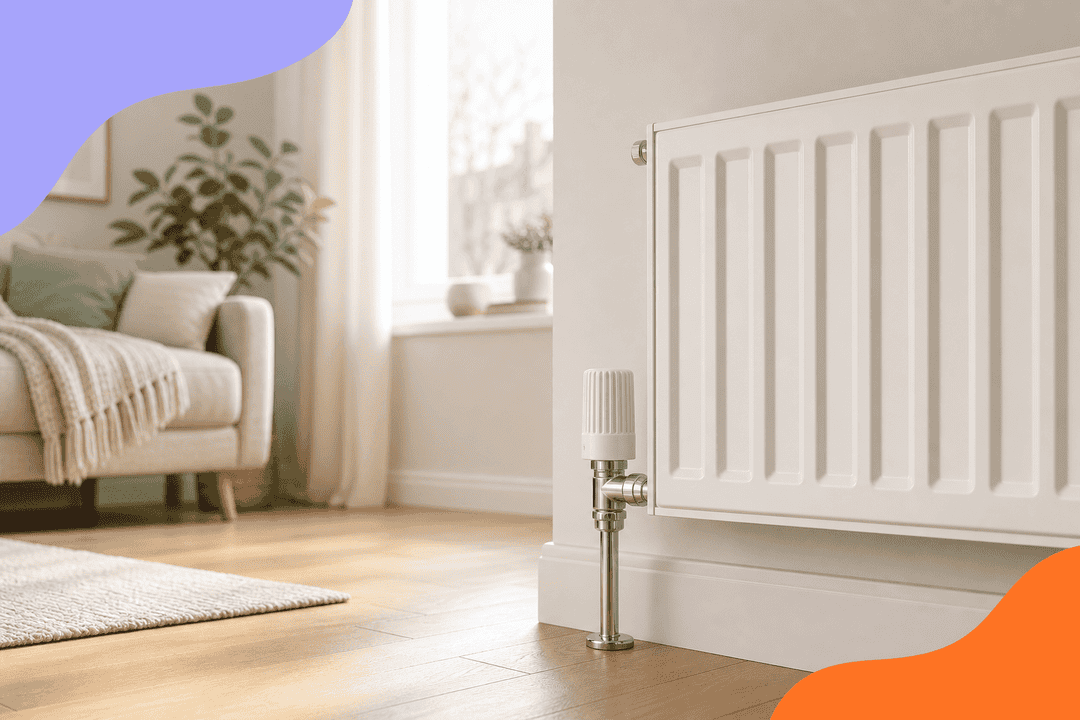
Thermostatic radiator valves, or TRVs, are the numbered heads on the side of most radiators. They let you set each room to a different temperature, so you're not heating rooms you don't use.
This guide explains what the numbers mean, what to set them to, and what to do when one sticks.
Quick answer
- Rooms you use most: around 3 to 4.
- Bedrooms and rooms you use less: around 2 to 3.
- Rooms you don't use: the frost setting (usually a snowflake or *), which stops the room getting cold enough to freeze.
- Room with the wall thermostat: leave that radiator fully open, or without a TRV, so the two don't work against each other.
- Radiator stuck cold: the pin under the TRV head has probably seized. You can usually free it yourself in a few minutes.
What is a thermostatic radiator valve?
A thermostatic radiator valve controls how much hot water flows into a radiator. The head contains a sensor, usually filled with wax or liquid, that expands as the room warms up. As it expands, it pushes down on a small pin in the valve, which gradually closes the valve and lets less hot water in. As the room cools, the sensor contracts and the valve opens again.
So a TRV doesn't set how hot the radiator gets. It sets roughly what temperature the room should reach, then turns the radiator down once it gets there.
What do the numbers on a TRV mean?
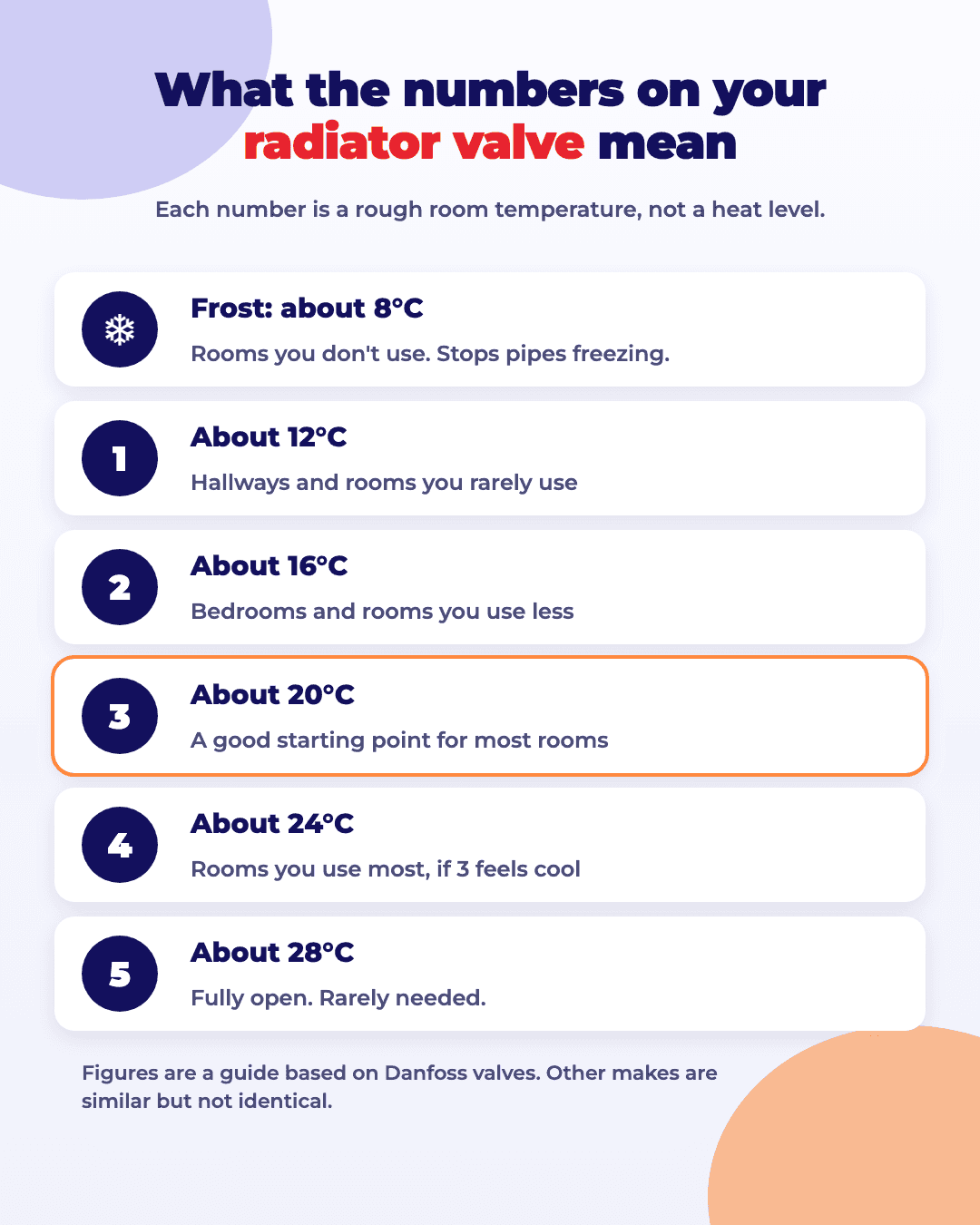
Most TRVs are numbered from 1 to 5, and some go from 0 to 6. Each number stands for a rough room temperature, not a heat level. On Danfoss valves, for example, the settings run from about 8°C to 28°C in steps of roughly 4°C, with 3 at about 20°C. Other makes are similar but not identical, and the exact temperature you get depends on where the radiator is and how the room holds its heat.
Two other marks are common:
- A snowflake or *: frost protection. The valve stays shut unless the room gets cold enough to risk freezing.
- 0: on some valves this closes the valve completely, with no frost protection.
What setting should my radiator valves be on?
The Energy Saving Trust suggests aiming for the lowest setting that keeps each room comfortable. As a starting point, it suggests 3 to 4 for the rooms you use most, and 2 to 3 for bedrooms and rooms you use less.
Give a room a day or so after changing the setting before you change it again. If it's too cool, turn the TRV up by one number. Turning a TRV right up to 5 doesn't warm a cold room any faster, because the valve is already fully open while the room is below its setting. It just lets the room carry on getting hotter once it's warm.
TRVs sense the air around them, so keep them clear of curtains, furniture and radiator covers. A TRV boxed in behind a sofa feels warmer than the room really is and closes too early.
Using TRVs with your room thermostat
The room thermostat on the wall switches the whole heating system on and off. TRVs then fine-tune each room. The two work best when they're not competing:
- Leave the radiator in the room with the wall thermostat fully open, or without a TRV. If that TRV shuts first, the thermostat never reaches its setting and keeps the heating on for the rest of the house.
- Set the wall thermostat to the lowest temperature you're comfortable with. For most people that's 18°C to 21°C.
- Use the TRVs to turn other rooms down, rather than turning the thermostat up to warm one cold room.
The boiler's own temperature setting matters too. Our guide to what temperature your boiler should be set at explains how the boiler dials and the wall thermostat fit together.
Do TRVs save money?
Yes, if you use them to turn down rooms you don't need warm. The Energy Saving Trust estimates that adding TRVs to a system that already has a programmer and room thermostat saves about £30 a year in Great Britain.
How much you save depends on how many rooms you turn down and how far. A spare bedroom on 2 rather than 4 uses noticeably less heat over a winter.
TRV not working? How to free a stuck radiator valve
If one radiator stays completely cold while the others heat up, and turning its TRV makes no difference, the pin under the head has probably seized. It often happens after the summer, when the valve has sat in one position for months.
- Turn the heating off and let the radiator cool.
- Turn the TRV head to its highest setting.
- Unscrew the collar or nut that holds the head on, and lift the head off. This doesn't let water out: the valve body stays sealed.
- Find the small metal pin in the middle of the valve. On a working valve, it springs back up when you press it. If it's stuck down, grip it gently with pliers and ease it up and down a few millimetres until it moves freely. Don't force it.
- Refit the head, set it back to your usual number and turn the heating on. The radiator should warm up within about 20 minutes.
If the radiator is warm at the bottom but cold at the top, or cold at the bottom but warm at the top, the valve probably isn't the problem. Trapped air or sludge is more likely. Our guide to radiators not heating up explains what each cold spot means.
When to call a heating engineer
- the pin won't move without force
- the valve drips or leaks after you refit the head
- the same valve keeps sticking, which usually means it's worn out
Replacing a valve means draining at least part of the heating system, so it's usually a job for a heating engineer.
How to stop TRVs sticking
When you switch the heating off for the summer, turn each TRV up to its highest setting and leave it there. That keeps the pin up, so it's less likely to stick. It's also worth turning each one down and back up a couple of times a year to keep it moving.
If several valves keep sticking, sludge in the heating water is a likely cause. Cleaning the system and adding inhibitor does more good than freeing pins one at a time.
Do you need TRVs when you get a new boiler?
In England, building regulations usually require each room to have its own temperature control when a boiler is replaced. This has applied since June 2022. In most homes, that means TRVs on the radiators, with no TRV in the room that has the wall thermostat. Working TRVs you already have can stay, and there are some exceptions, for example open-plan single-storey homes. Wales and Scotland have their own regulations.
If you're replacing your boiler with BoxHeat, you can add TRVs when you order. A new combi boiler starts from £1,799 fully installed (correct in November 2026), with monthly finance available, subject to status. You can get your fixed price online in under 2 minutes, and our guide to the boiler replacement process explains what happens on the day.
Radiator valve questions
Thinking about a new boiler? See your fixed price
Get my fixed priceReviewed by our technical team. All BoxHeat articles are written by experienced heating professionals and reviewed by our team of Gas Safe registered engineers to ensure accuracy, safety, and compliance with current UK building regulations and manufacturer guidelines.