In this article
Most like-for-like boiler replacements take a single day, and your heating and hot water are normally back on before your Gas Safe registered engineer leaves.
Jobs that change more, such as converting to a combi or moving the boiler, take longer. This guide shows typical timings, then explains what happens before, during and after the installation, so you know what to expect and how to prepare.
Quick answer
- A like-for-like replacement usually takes 1 day.
- Converting to a combi, replacing a back boiler or moving the boiler usually takes no more than two days.
- Your engineer removes the old boiler, fits the new one, cleans and protects the system, tests everything and shows you how it works.
- An adult needs to be at home, and you'll be without heating and hot water while the work is done.
How long does a boiler replacement take?
It depends mostly on how much is changing. Swapping a boiler for the same type in the same place is the quickest job. Changing the boiler type, moving it or running a new flue adds work.
| Type of job | Typical time |
|---|---|
| Like-for-like replacement (same type, same place) | Usually 1 day |
| Regular or system boiler to a combi | Usually no more than 2 days |
| Back boiler to a combi | Usually no more than 2 days |
| Moving the boiler | Usually no more than 2 days |
Conversions take longer because the hot water cylinder and any cold water tanks that are no longer needed are taken out, and the pipework is changed to suit a combi. A back boiler is removed from the fireplace and its gas supply safely capped off, and the new combi is fitted in a new position with its own flue. Moving the boiler means new pipework and usually a new flue position.
These are typical times. An older or harder-to-reach system can take a little longer.
Your quote is based on your home, so any extra work is planned and included in your fixed price before installation day. Our boiler replacement cost guide explains what affects the price, and when you're ready, you can get your fixed price online.
Before your boiler replacement
Your quote is based on the information you give us about your home and your current heating system, so the boilers we recommend and your fixed price are tailored to it.
Where extra work is needed, such as moving the boiler or changing boiler type, it's identified during the quote and included in your installation plan. Our guide to what's included in a boiler installation sets out exactly what comes as standard.
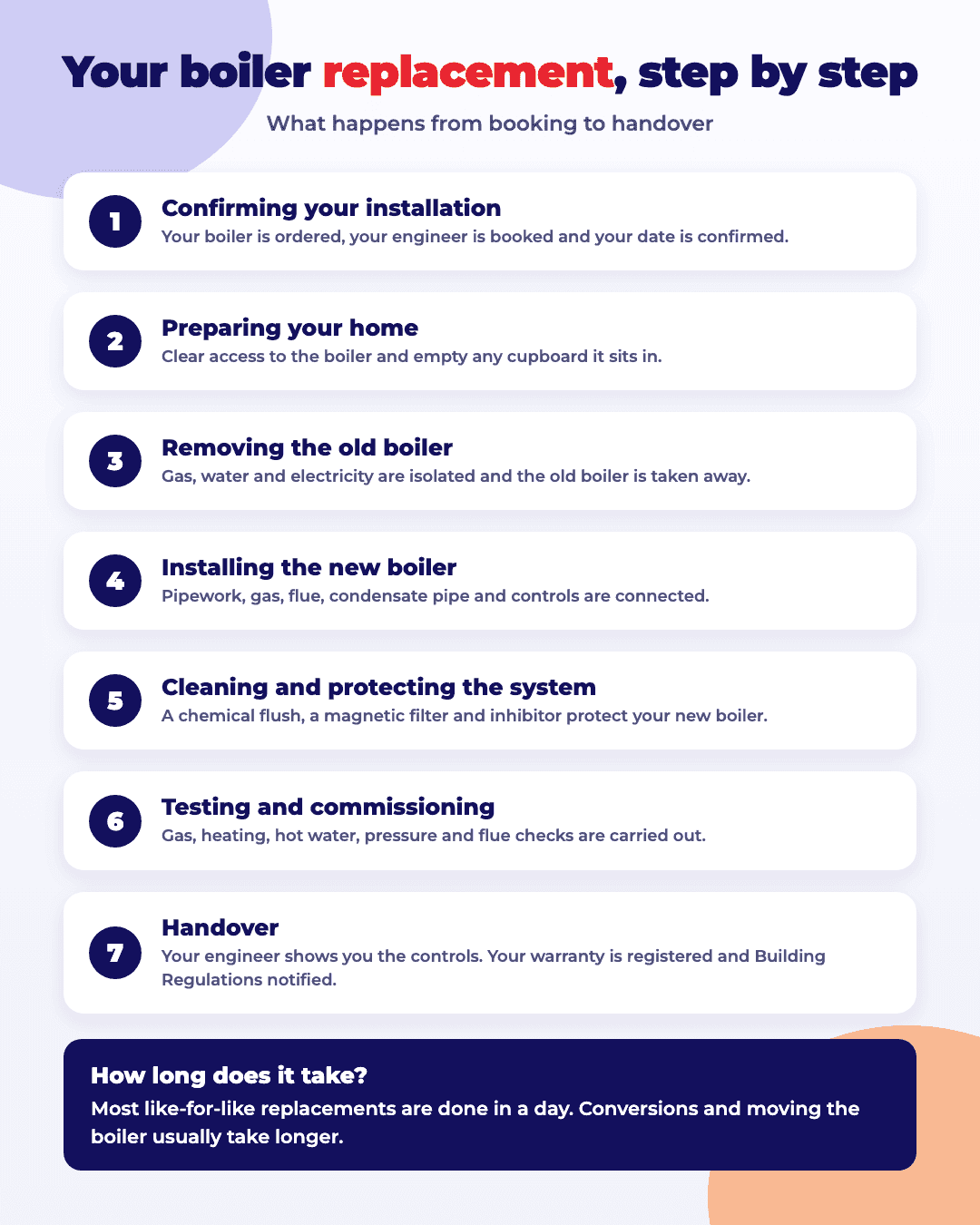
Step 1: Confirming your installation
Once you've placed your order and chosen an installation date, everything is arranged in advance:
- Your chosen boiler is ordered.
- Any extra materials are confirmed.
- Your Gas Safe registered engineer is booked.
- Your installation plan is prepared.
After you've placed your order, we'll ask you to send photos of your boiler, the area around it and the flue, so our technical team can check everything matches your answers. You'll also receive confirmation of your installation date.
Step 2: Preparing your home
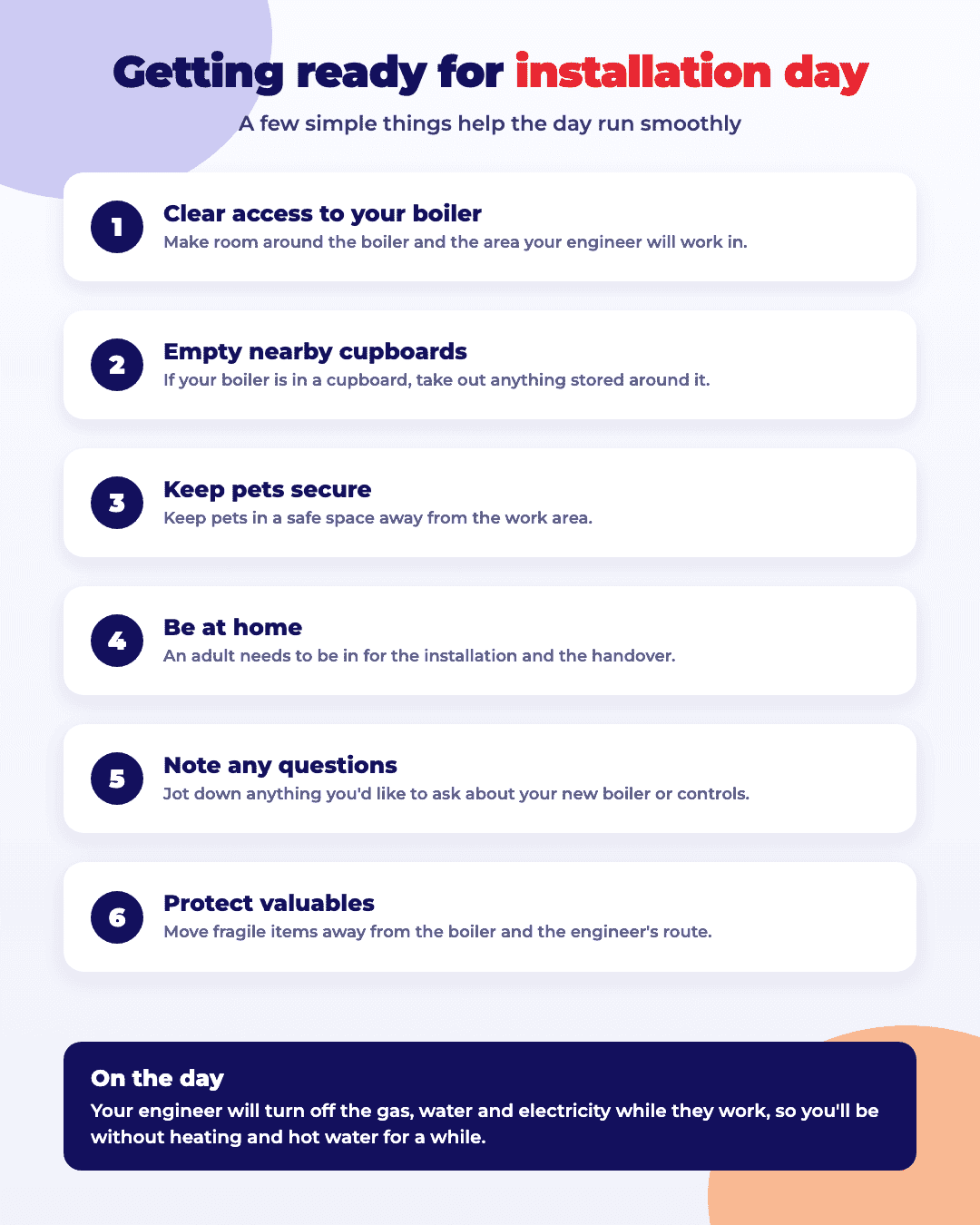
There isn't usually much to do. To help the day run smoothly:
- Clear access to the existing boiler.
- Empty any cupboard the boiler sits in.
- Make sure an adult is at home throughout the installation.
- Keep pets and children away from the work area where possible.
- Move fragile or valuable items away from the boiler and the engineer's route.
Step 3: Removing the old boiler
Your engineer first isolates the gas, electricity and water supplies where needed. The old boiler is then disconnected and removed. If you have a back boiler, the gas supply to the fireplace is safely capped off.
For a like-for-like replacement this is usually straightforward. If you're converting to a combi boiler from a regular or system boiler, the hot water cylinder and any cold water tanks that are no longer needed are also removed.
Step 4: Installing the new boiler
The new boiler is fitted and connected to your heating system. Depending on your home, this may include:
- Connecting the heating pipework.
- Connecting the gas supply.
- Fitting or connecting the flue.
- Connecting the condensate pipe.
- Fitting your heating controls.
Step 5: Cleaning and protecting the system
As part of every BoxHeat installation, your heating system is cleaned and protected to help your new boiler last:
- Flushing the system with a chemical cleaner to remove sludge and debris.
- Fitting a magnetic system filter.
- Treating the system with inhibitor to help prevent corrosion.
Step 6: Testing and commissioning
Before the boiler goes into normal use, your engineer carries out safety and performance checks. These typically include:
- Checking the gas supply is sound and leak-free.
- Testing the heating and hot water.
- Checking the system pressure.
- Checking the flue.
- Commissioning the boiler to the manufacturer's instructions.
Step 7: Handover
Before leaving, your engineer explains how to use your new boiler and heating controls, including how to top up the pressure if needed.
We register your boiler with the manufacturer for its warranty, subject to the manufacturer's terms, and notify Building Regulations. You'll receive the paperwork for both.
Will I be without heating?
Yes, for part of the day. Your old boiler is disconnected during the work, so heating and hot water are off until the new boiler has been tested and commissioned. For a straightforward replacement, they're normally back on before the engineer leaves.
After your installation
You can use your new boiler straight away. To keep it running safely and efficiently:
- Have it serviced every year by a Gas Safe registered engineer, in line with the manufacturer's recommendations.
- Keep your warranty paperwork somewhere safe.
- Contact a Gas Safe registered engineer if you notice a fault.
Regular servicing helps keep your boiler reliable and is usually a condition of the manufacturer's warranty. Our guides to how long a boiler lasts and keeping your boiler warranty valid explain more.
Frequently asked questions
Get your fixed price for a new boiler
Get my fixed priceReviewed by our technical team. All BoxHeat articles are written by experienced heating professionals and reviewed by our team of Gas Safe registered engineers to ensure accuracy, safety, and compliance with current UK building regulations and manufacturer guidelines.