In this article
Finding water under your boiler is worrying, but most leaks have a simple cause. Some, like high pressure, you can deal with yourself. Others need a Gas Safe registered engineer. Either way, it's best to act quickly: even a slow drip can damage floors and ceilings, and water and electrics don't mix.
Quick answer: what to do right now
- Switch the boiler off.
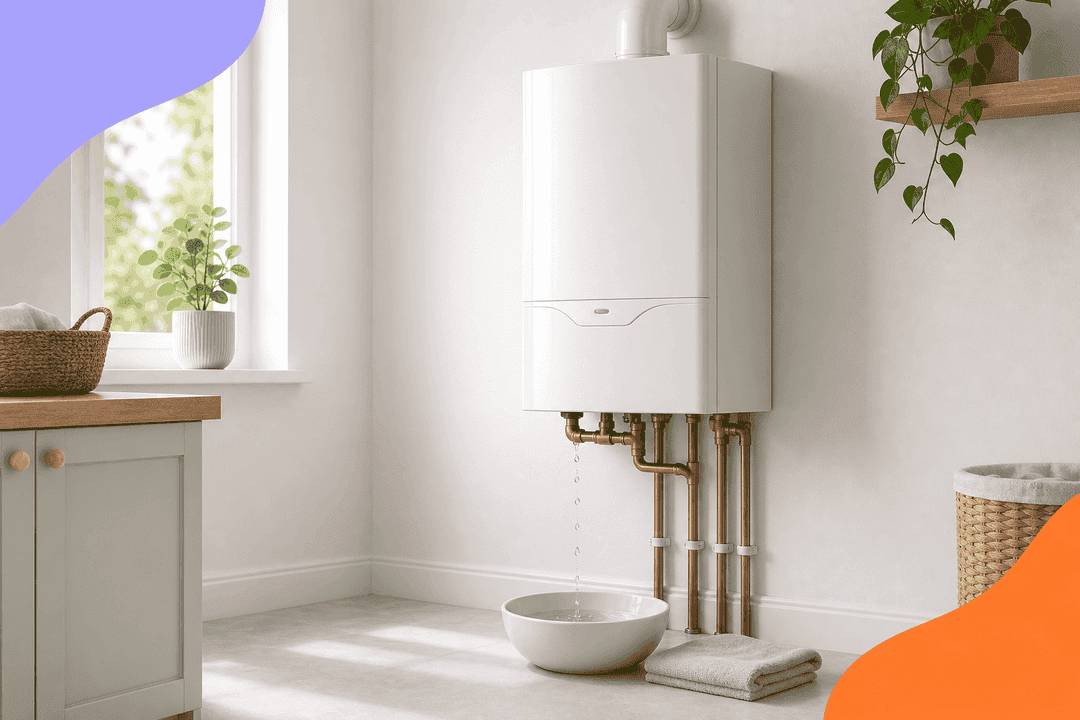
- Put a bowl or towel underneath to catch the water, and mop up any puddles.
- If water is pouring out, turn off the water supply at your main stopcock.
- Check the pressure gauge and note where the water seems to be coming from.
- Call a Gas Safe registered engineer if the cause isn't obvious. Never take the boiler casing off yourself.
Why is my boiler leaking?
Where the water is coming from is the best clue to the cause:
| Where the water is | Likely cause | What to do |
|---|---|---|
| From a small pipe on the outside wall | The pressure relief valve is letting water out because the pressure is too high, or the valve is faulty | Check the gauge. If it's above 2 bar with the heating off, bleed a radiator. If it keeps dripping, call an engineer |
| Pipe joints under the boiler | A loose fitting, or a worn or corroded seal | Dry it and watch where the drip forms, then call an engineer |
| From inside the casing | An internal part, such as a pump seal or the heat exchanger | Switch off and call an engineer |
| The white plastic condensate pipe | A blocked condensate pipe, or a frozen one in cold weather | Check the pipe outside isn't blocked or frozen. If you're not sure, call an engineer |
| Around a radiator or its valves | A radiator valve leak, not the boiler | Tighten or replace the valve, or call a plumber |
The most common causes explained
Pressure too high
Every combi and system boiler has a pressure relief valve. If the pressure gets too high, usually around 3 bar, it opens and lets water out through a pipe that runs outside. The most common reason is too much water added when topping up the pressure, or a filling loop left open. Bring the pressure back down by bleeding a radiator with the heating off. Our boiler pressure guide explains how. If the pipe keeps dripping when the pressure is normal, the valve itself may need replacing.
Loose fittings and worn seals
Over time, the seals where pipes join can wear or corrode, and fittings can work loose. Dry the pipes, then watch to see exactly where the water appears, so you can tell the engineer. Don't try to tighten fittings under the boiler yourself: one of those pipes is the gas supply.
Corrosion and a failing heat exchanger
Water dripping from inside the boiler can mean an internal part is failing. One of the more serious causes is a corroded or cracked heat exchanger, which is more common in older boilers. This is always a job for a Gas Safe registered engineer.
If you smell gas
A water leak isn't a gas leak. But if you can smell gas:
- Open doors and windows.
- Don't smoke, light matches or use any naked flame.
- Don't switch electrical items on or off, including lights.
- Turn off the gas at the emergency control valve next to the meter, if you can safely reach it and it isn't in a cellar or basement.
- Leave the property and, once outside, call the National Gas Emergency Service on 0800 111 999. It's free and open 24 hours a day.
Repair or replace?
A leak from a loose fitting, a seal or the pressure relief valve is usually a straightforward repair. If your boiler is still under warranty, check with the manufacturer first, as a faulty part may be covered.
A leaking heat exchanger in an older boiler is different. It's one of the most expensive parts to replace, so if your boiler is more than 10 to 15 years old, it's often worth comparing the repair quote with the cost of a new boiler. Our guide to how long a boiler lasts covers the other warning signs.
With BoxHeat, a new combi boiler starts from £1,799 fully installed (correct in October 2026). You can get a fixed price for a new boiler online and compare it with your repair quote.
Leaking boiler questions
Is your old boiler worth fixing? See your fixed price for a new one
Get my fixed priceReviewed by our technical team. All BoxHeat articles are written by experienced heating professionals and reviewed by our team of Gas Safe registered engineers to ensure accuracy, safety, and compliance with current UK building regulations and manufacturer guidelines.